
Frisian Duck: Cannabis Leaves With a Duck-Foot Plot Twist

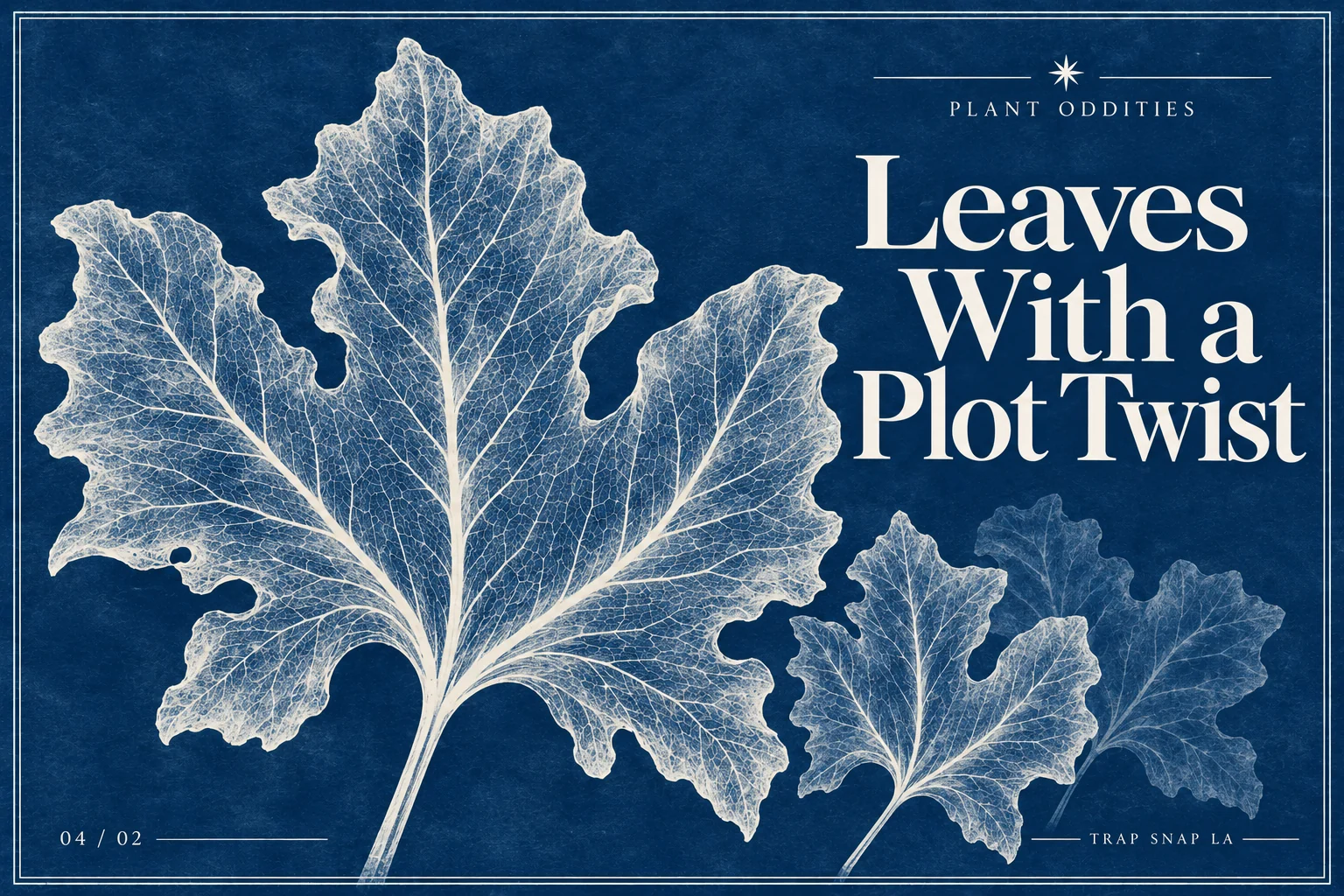
Plant Oddities · Episode 2 of 7
If the cannabis-leaf logo had a cousin who refused to dress like the rest of the family, Frisian Duck would be that cousin. The leaves have a broad, connected appearance that makes the usual pointed outline feel strangely optional.
The duck reference is not just a random name from somebody’s group chat. Dutch Passion’s own description connects it to the shape of a duck’s footprint. The result is a cultivar that makes a useful point about cannabis: the most recognizable version of a leaf is not the only version worth looking at.
See the real plant: View the breeder’s original Frisian Duck strain photographs.
A leaf with fewer obvious gaps
Dutch Passion describes Frisian Duck as having webbed leaves and attributes it to a cross involving its Frisian Dew and a selected Ducksfoot line. In the company’s account, the unusual shape is the defining visual feature.
Think about the negative space in a conventional cannabis-leaf graphic. The spaces separating the pointed sections do almost as much recognition work as the green parts. Frisian Duck changes that balance. More connected-looking leaf surface produces an outline that reads differently, especially when the leaf is seen at a distance.
The duck-foot comparison helps because it directs attention to shape rather than inventing a new botanical category. It is a nickname for a resemblance, not a suggestion that the plant belongs to the vegetable patch’s aquatic-bird department.
See the real plant
Frisian Duck: the real photo tour — Scroll through the leaf photos and find the duck-foot shapes. This is the one to send somebody who thinks every cannabis leaf looks like the logo.
The whole plant tells a different story than a cropped leaf
A close crop can make Frisian Duck seem like a single strange object. Pull back and the interest shifts: how does that leaf shape repeat across a plant, and how does it sit beside the flowers? A good portrait keeps those relationships visible.
The breeder’s illustrated feature includes a gallery intended to show the unusual foliage. Its description also allows variation in flower coloration. That gives a photo editor a reason to show more than one view, rather than selecting the most dramatic image and treating it as the complete definition.
Our guide to cannabis plant details explains why a leaf, a stigma and a trichome answer different anatomical questions. Frisian Duck’s outline is eye-catching, but it does not make the flower structures irrelevant.
Resemblance is not an identification guarantee
There is a satisfying little brain glitch when the image in front of you refuses to match the symbol you already know. That is the entertainment here. The less useful version is deciding that you can positively identify any unfamiliar plant from one look.
A photograph can document the specimen it actually shows, especially when it comes with a named source and a caption. It cannot confirm an unrelated specimen’s identity just because the outline looks similar. A shared visual trait is not a complete chain of records.
The same applies in the other direction. A plant that lacks the standard fan-leaf outline does not automatically cease to be cannabis. The difference between recognition and verification is easy to miss precisely because recognition usually happens so fast.
The name has a visual job
Frisian Duck is a particularly readable name once the appearance is explained. It carries a place reference through the Frisian family and a shape reference through the Duck part. You do not need a paragraph of exaggerated adjectives to understand why somebody remembered it.
That is a useful counterexample to the idea that every unusual cannabis name is pure nonsense. Some names are jokes, some come from records and some point toward a trait. None of those naming choices makes a label self-verifying, but a documented explanation can still add to the story.
Our collection of unusual strain names explores that wider naming culture. Frisian Duck earns its place through a detail you can actually discuss, rather than an invented promise about how a person will feel.
Why this portrait belongs in the series
This is a foliage episode. Colorful flower photographs have their own appeal, but Frisian Duck asks you to notice the part of cannabis culture that usually gets reduced to a logo.
The broad outline is the detail to notice in Dutch Passion’s linked photographs. Compared with the familiar fan of narrow leaflets, it makes the duck-foot nickname easy to understand. The interesting contrast is anatomical: this is cannabis foliage with a different silhouette, rather than a different plant family hiding behind a familiar name. A Frisian Duck vs Ducksfoot comparison should distinguish the named descendant from the parent line in Dutch Passion’s account.
Sources
Series cover: original AI-assisted editorial illustration for Trap Snap LA. Photographs carry their own credits.
Questions about Frisian Duck’s webbed leaves
Is Frisian Duck identical to the Ducksfoot parent line?
The breeder describes Frisian Duck as a cross involving Frisian Dew and a selected Ducksfoot line. A named descendant and one of its reported parents are different entries in that account.
Do webbed cannabis leaves mean the flowers are webbed too?
No such conclusion follows. Dutch Passion describes unusual leaves alongside more conventional cannabis buds. Leaf-outline language should not be transferred to every plant structure.
Does Frisian Duck’s unusual leaf shape mean it has no cannabis aroma?
The breeder’s account explicitly describes normal cannabis aroma despite the webbed foliage. Appearance and aroma are different traits, and this remains an attributed producer description.
Can a duck-foot-shaped leaf prove an unknown plant is Frisian Duck?
No. Phenotype means observable traits influenced by genes and environment. A resemblance is a visual clue, not a complete source record or cultivar confirmation.
Tags: Frisian Duck vs Ducksfoot leaf shape; webbed cannabis leaves and flower anatomy


