
What cannabis terpenes are and why weed smells different

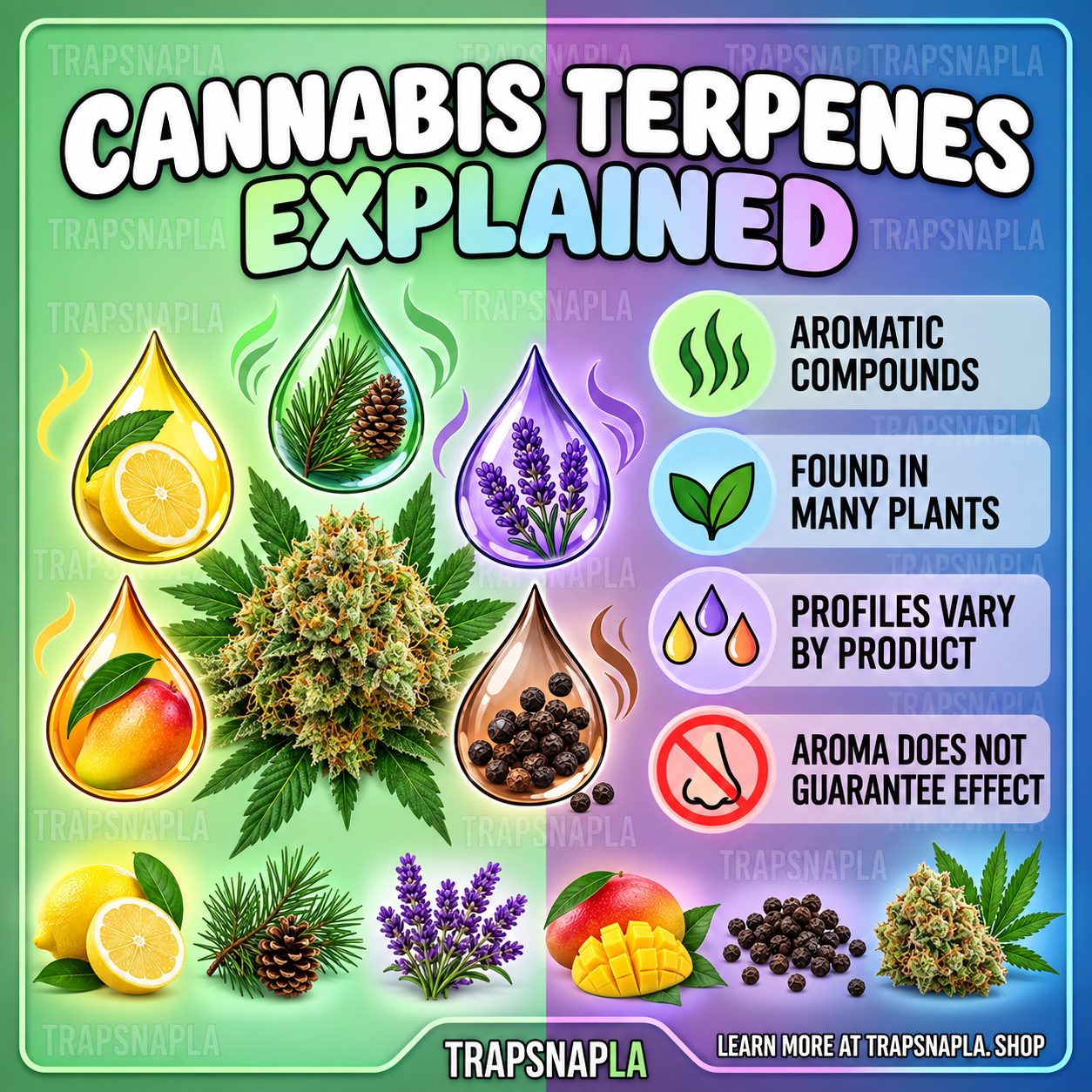
Why can one cannabis sample smell like citrus peel while another smells earthy, piney, or almost floral? A big part of the answer is terpenes.
If you’ve seen a colorful chart assigning each terpene a personality, though, you’ve probably seen the explanation get ahead of the evidence. Smell is one thing. A guaranteed mood, health benefit, or predictable high is another.
The useful explanation of what cannabis terpenes are is straightforward: terpenes help explain aroma, and researchers are studying what some of them may do in specific combinations. That’s interesting enough without pretending every scent comes with a reliable instruction manual for your brain.
What terpenes actually are
Terpenes are a large group of compounds found in many plants, including cannabis. They contribute to familiar smells in citrus, herbs, flowers, and other plant material.
In cannabis, they’re part of a broader mixture of aromatic compounds. They’re important, but they aren’t the only contributors to every smell. A complete aroma can involve several compounds interacting with your sense of smell at once.
That’s why identifying one terpene doesn’t fully describe a sample. Knowing that a song has a guitar doesn’t tell you what the whole song sounds like. The surrounding mixture and relative amounts still matter.
A few names you are likely to see
Limonene is commonly associated with a citrus-like aroma. Pinene is associated with pine-like notes. Linalool is often described as floral. Myrcene is commonly described as earthy or musky, while beta-caryophyllene is associated with peppery or spicy notes.
Those are aroma descriptions, not guaranteed effects. They help translate unfamiliar ingredient names into smells people recognize.
The same sample can contain several of these compounds, and its overall scent may not neatly match any single description. A dominant terpene is simply the most prominent among those measured in that report, not the only one present or the automatic explanation for every aspect of the product.
Cannabis does not have exclusive rights to them
Finding a terpene in cannabis doesn’t mean the compound exists only in cannabis. Many occur across different plants.
The same molecule can have the same chemical identity when obtained from different sources. But two mixtures containing that molecule aren’t necessarily equivalent. Their amounts, other ingredients, and intended routes of exposure can differ substantially.
This becomes relevant when a label mentions cannabis-derived or botanically derived terpenes. The source description is useful information, but it doesn’t settle every question about the finished blend. You still need to know what was added, how it’s described, and what claims are actually being made.
Where the simple effects charts go too far
An aroma chart may say that one terpene means relaxation and another means focus. The problem is the certainty. A finding about a compound under one set of conditions can’t automatically predict a commercial product’s effect on every person.
Amount matters. Route matters. The other compounds in the mixture matter. A result in cells or animals is also not the same as a demonstrated benefit in people using a finished product.
You can appreciate a clear explanation without accepting a guaranteed mood assignment. “This contributes a citrus-like aroma” is a narrower, better-supported kind of statement than “this will make you happy.” The first describes a characteristic. The second predicts a personal outcome.
What one human study found about limonene
A controlled study examined vaporized d-limonene alongside THC and found reduced anxiety-related effects under some of the tested conditions. That’s an interesting result because it asks a specific question in people rather than relying only on a theoretical explanation. [2]
It still doesn’t establish that any citrus-smelling product prevents anxiety. The study used defined compounds, amounts, and conditions. A retail product with a different mixture isn’t automatically the same experiment.
It also doesn’t make citrus fruit or a scented household product an antidote to THC. That leap changes the substance, the route, and the situation. A promising result is a reason for further research, not permission to skip those differences.
What a receptor study can and cannot tell us
Another study tested selected terpenoids in cannabinoid-receptor experiments and didn’t find support for the proposed interactions under those conditions. [3]
That’s useful evidence against a specific explanation in that setup. It doesn’t prove that every terpene is inactive in every possible way. A study answers the question it was designed to test, not every related question on the internet.
This is why two headlines can sound like they disagree even when the experiments are different. One may examine a receptor mechanism in a lab. Another may measure anxiety in people. To compare them fairly, keep track of what each study actually measured.
Why storage affects aroma
Aroma isn’t a permanent feature that gets locked in on packaging day. Aromatic compounds can be lost or change as cannabis is processed and stored. Temperature, light, and time can influence the chemical picture. [1]
That helps explain why an older sample may smell different from its original description. But a weaker smell doesn’t reveal an exact remaining THC amount, and a strong smell doesn’t prove the absence of contamination.
These are separate observations. Aroma can tell you what you’re noticing with your nose. It can’t perform a potency panel or a microbial test. A familiar smell should not be given more authority than it actually has.
How to read a terpene report
Start with the sample and batch information. A detailed terpene profile is less useful if it belongs to a different batch or a different product altogether.
Next, check the units. Percentages and milligrams per gram describe concentration in different ways. Also notice whether the report lists individual compounds, a total of measured terpenes, or both.
The word “measured” matters because a lab panel may cover selected compounds rather than every aromatic substance present. A compound missing from a short list isn’t automatically proven absent. The report is a map of the tests performed, not a complete inventory of everything a nose could detect.
Added flavor does not automatically mean inhalation safety
An ingredient’s use in food does not, by itself, establish that breathing it in is safe. Swallowing a substance and breathing an aerosol containing it are different exposures.
This is especially important when aroma language makes a formulation sound familiar or harmless. “Found in fruit” is a source description. It isn’t a completed safety assessment for every concentration and route.
Likewise, a product being described as terpene-rich doesn’t mean more is automatically better. The amount and the full formulation matter. Treating a pleasant smell as proof of suitability for every use confuses a sensory observation with an entirely different kind of evidence.
A good description can still be interesting
There’s plenty to say about terpenes without assigning them magical powers. A profile can explain why a sample smells citrusy, woody, floral, or spicy. It can show differences between batches and help describe how an aroma changes over time.
Research can also be explained honestly: what was tested, what happened, and what remains uncertain. That’s more useful than a chart that turns early findings into universal promises.
The sweet spot is being curious without being overly certain. A compound doesn’t become boring just because we admit that researchers are still figuring out which effects matter in real-world combinations.
The takeaway
Terpenes are an important part of cannabis aroma. They also belong in a real research conversation about how compounds may interact, but that conversation is more specific and less settled than many labels suggest.
Use terpene names to understand ingredients and aroma. Treat guaranteed effect claims with more caution, especially when they jump from one study to every product containing the same compound.
In short, a smell can tell an interesting story. It can’t tell your whole future.
Related educational article
Indica vs Sativa vs Hybrid: What Labels Really Mean
Sources
1. Milay and colleagues — Cannabis aromatic compounds during storage.
2. Spindle and colleagues — D-limonene and THC anxiety trial.
3. Santiago and colleagues — Terpenoids and cannabinoid receptor activity.
Questions about cannabis terpenes and aroma
Are terpenes the same as cannabinoids?
No. They are different chemical categories. The postharvest study analyzed phytocannabinoid and terpenoid profiles separately. A terpene percentage does not represent THC content, and the groups can change differently during storage.
Are sulfur compounds in weed a type of terpene?
No. Volatile sulfur compounds are a separate part of the aroma chemistry. ACS describes the research identifying skunky sulfur compounds. They should not be relabeled as terpenes simply because they contribute to the same smell.
Can weed with similar terpenes smell different?
Yes. The 2023 chemistry and sensory study found similar major-terpene patterns across samples with different aromas. Smaller amounts of nonterpenoid compounds helped explain specific sweet and savory differences in those samples.
Does a higher terpene percentage mean more exotic smelling weed?
That is not a reliable conclusion. In the 2023 study, total volatile concentration did not track the panel’s “exotic” aroma score. The finding concerns those samples and sensory ratings; it does not rank all cannabis.
Tags: cannabis terpenes vs sulfur compounds; same terpenes different cannabis smell



Trap Snap LA editorial note: A terpene source description is only one part of an ingredient list. Our distillate versus live resin comparison explains why the final formulation still matters.