
Why Edibles Take Longer to Kick In Than Smoking Weed

“I don’t feel anything yet” is probably the most misleading sentence in the entire edible conversation.
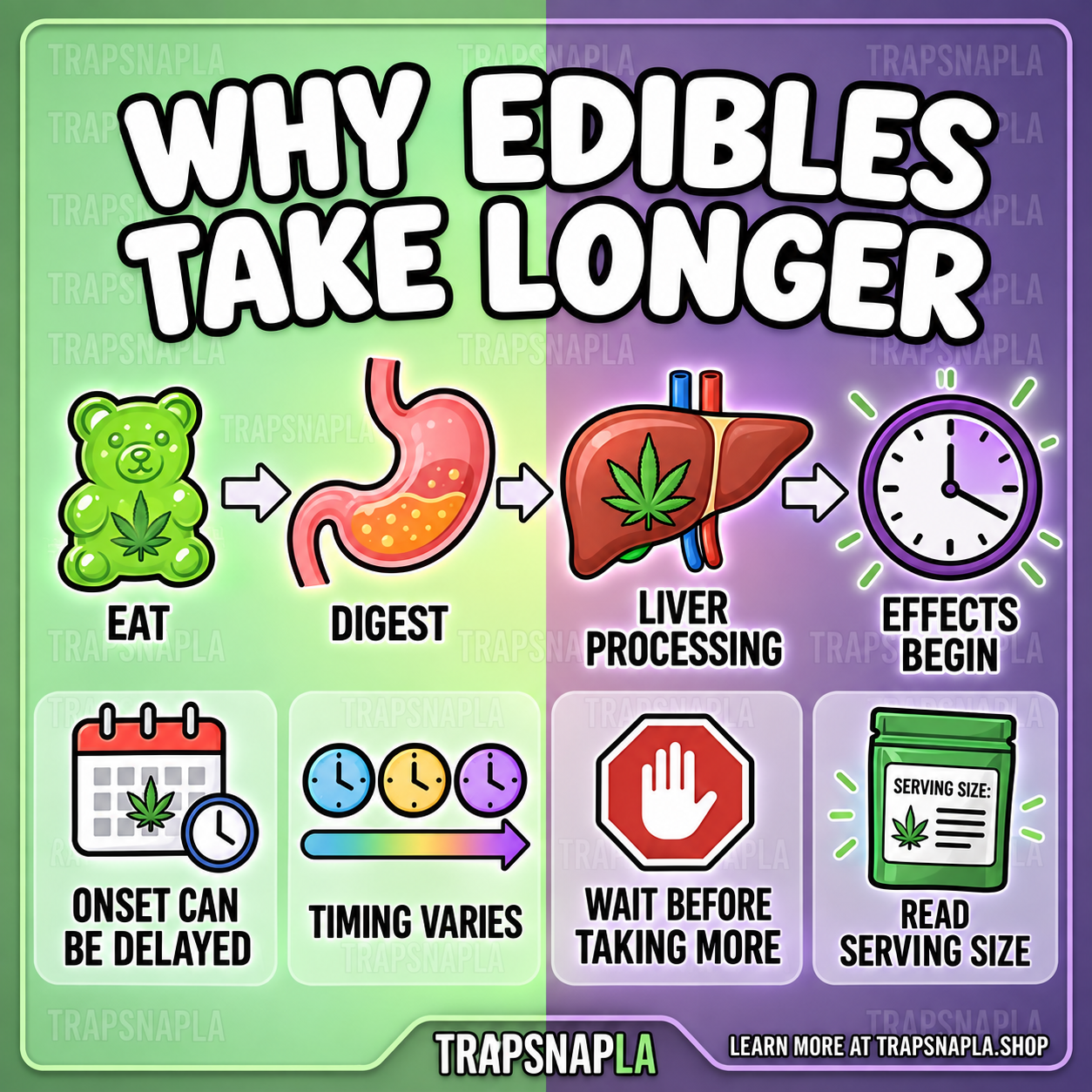
An edible can seem quiet at first because swallowed THC takes a different route through the body than inhaled THC. There’s digestion involved, plus processing that changes how the experience develops. The delay doesn’t mean the product is inactive or that the rest of the night is already predictable.
Understanding why edibles take longer to kick in makes the timing less mysterious. It also explains why judging an edible by the first few minutes can go badly. Here’s the version that doesn’t require remembering your biology textbook.
For the bigger timing picture, see our guide to how long weed effects last.
Smoking and swallowing take different routes
When THC is inhaled, it can move from the lungs into the bloodstream relatively quickly. Swallowed THC has a longer trip. It moves through the digestive system and is processed in the body before the full effects become clear. [1, 2]
Think of it as two different delivery routes, not two products racing along the same road. One reaches its first stop sooner. The other has extra stops that affect the timing and the outcome.
That’s why an experience with an inhaled product doesn’t translate neatly to an edible. Knowing what one route felt like doesn’t give someone a reliable timer for the other.
The liver is part of the explanation
During processing, the body can turn THC into another active compound called 11-hydroxy-THC. The name sounds technical, but the key point is straightforward: the body doesn’t simply pass the original THC along unchanged.
This helps explain why oral THC can feel different from inhaled THC. It isn’t just the same experience arriving late. The route and processing change the picture.
You may see this simplified online as “edibles are always stronger.” That’s too broad. The actual amount, formulation, absorption, and individual response still matter. The useful lesson is that swallowing and inhaling are different exposures, not that one fixed comparison works for everyone. [2]
Onset and peak are not the same moment
Onset is when someone first notices an effect. Peak is when the effects are strongest. Duration is how long they continue. Those are three separate questions, even though people often bundle them together as “how long it takes.” For the broader timeline, see how long weed effects can last.
The CDC describes edible effects as taking about 30 minutes to two hours to begin. That’s a general description, not a promise that every person will follow the same schedule. It’s also not an instruction about when to take more. [1]
Feeling something doesn’t mean the effects have finished building. Likewise, not feeling something early doesn’t prove there’s no more effect coming. The timeline has more than one stage.
Why your friend is not a reliable stopwatch
Two people can eat products with the same labeled amount and notice different timing. Their bodies may absorb and process THC differently. What they have eaten, the product itself, and other personal factors can affect the experience. [1]
Even one person’s previous experience isn’t a guarantee for the next occasion. A familiar package can make the situation feel predictable, while the conditions around it have changed.
This is why “mine usually starts by now” is an observation, not a rule. It might be accurate about someone’s past experiences without being useful for judging another person’s present situation. No one else’s timeline can confirm that a delayed edible has stopped developing.
Food can change the picture
People often want a simple rule about eating before an edible. The honest explanation is that food can affect absorption and timing, but there’s no single meal-based shortcut that makes the response predictable for everyone.
The product’s ingredients and formulation matter as well. A gummy, a baked item, and a drink aren’t automatically identical just because each lists THC. Marketing terms about rapid onset should not be treated as a personal guarantee.
The goal is to understand how timing varies, not to make the effects stronger. When several factors can change the timing at once, the safer conclusion is that the clock alone can’t tell the whole story.
Why taking more too early causes problems
The delay creates an easy misunderstanding: nothing noticeable has happened, so the first amount must not count. But the first amount may still be on its way through the body.
Adding more can mean the effects overlap later. What started as impatience can turn into a much more intense experience than expected. The CDC identifies delayed effects as one reason edibles can lead to poisoning or unexpectedly high exposure. [1]
This isn’t a willpower issue or a test of experience. It’s a timing problem. Treating the absence of an early feeling as proof of the absence of THC is the mistake. The body has not provided that proof.
A package can contain more than one serving
Before timing even enters the conversation, the label can cause confusion. A single package, candy, or baked item doesn’t necessarily equal one labeled serving.
Check whether the THC amount is listed per serving, per piece, or per package. Those phrases can describe very different totals. Also distinguish milligrams of THC from the weight of the food itself or a combined cannabinoid number.
This is label literacy, not a suggested amount to take. If the amount is unclear, guessing doesn’t become more reliable because the food looks small. A tiny item can contain multiple labeled servings, while a larger-looking snack can have a different concentration entirely.
Feeling better is not a driving clearance
The point when someone feels less high isn’t necessarily the point when attention, coordination, and judgment are back to normal. Cannabis can affect abilities needed for safe driving. Alcohol and other impairing substances can make the situation riskier. [3]
There’s no universal edible countdown that proves a person is ready to drive. A timer measures elapsed time; it doesn’t measure reaction time or decision-making.
Coffee, a shower, or an energetic conversation can’t certify that impairment is gone. If the evening includes an edible, transportation should not depend on guessing when the effects will end. Don’t drive while impaired or use a general timing chart as permission to do so.
When someone feels unwell
If someone becomes very anxious or uncomfortable, help them get to a calm, safe place and have a trusted, unimpaired person stay nearby. Avoid adding alcohol, more cannabis, or other substances in an attempt to fix the feeling.
Don’t assume every symptom is harmless just because cannabis was involved. Severe chest pain, trouble breathing, seizures, collapse, or someone who can’t be awakened call for emergency help. In the United States, call 911 for an emergency. Poison Control can advise on suspected poisoning at 1-800-222-1222. [1]
Keep the packaging available for professionals if possible. What was taken, roughly how much, and when are more useful details than trying to describe whether the edible seemed “strong.”
Edibles need food level visibility and medicine level security
An edible may look like an ordinary snack to a child, visitor, or anyone who can’t see the original label. That makes storage a separate safety issue from adult timing.
Keep cannabis products in their original, clearly labeled packaging and locked away from children and pets. Child-resistant packaging is helpful, but it doesn’t replace secure storage. Avoid moving edible products into an ordinary candy jar or an unmarked food container. [1]
If a child may have eaten a cannabis product, seek Poison Control guidance promptly rather than waiting for obvious effects. The very delay that confuses adults can also delay recognition of an accidental exposure.
The short explanation to remember
Edibles take longer because swallowed THC follows a slower, more complicated route than inhaled THC. Digestion, processing, product formulation, and individual differences all influence the result.
The important distinction isn’t just “fast versus slow.” It’s that onset, peak effects, and the end of impairment are different things. None can be reliably guessed from the first few quiet minutes.
So when an edible seems to be doing nothing, the useful thought is not “it failed.” It is “the timing is still uncertain.” That small change in how you read the situation matters.
Sources
1. CDC — Cannabis and poisoning.
2. NIH NCCIH — Cannabis and cannabinoids.
3. CDC — Cannabis and driving.
Questions about edible timing and metabolism
Is 11-hydroxy-THC the same as THCA?
No. THCA is a plant cannabinoid precursor; 11-hydroxy-THC is an active metabolite formed when the body processes THC. NIST’s chemistry discussion and dronabinol prescribing information describe those different roles.
Do cannabis drinks count as edibles?
Yes. CDC includes cannabis-infused drinks in its edible category. A beverage is an oral product, so its name or liquid format does not guarantee the rapid timing associated with inhalation.
Can an edible contain food allergens as well as THC?
Yes. THC content says nothing about milk, nuts or other food ingredients. California’s manufactured-product labeling checklist requires ingredient information and applicable major-allergen declarations. Read those alongside the cannabinoid panel.
Tags: 11-hydroxy-THC vs THCA difference; cannabis drink edible onset explained



Trap Snap LA editorial note: A serving amount and a package total can describe different quantities. Our THC percentage explainer covers concentration and total amount so those label fields are easier to distinguish.