
THCA vs THC and what the difference means

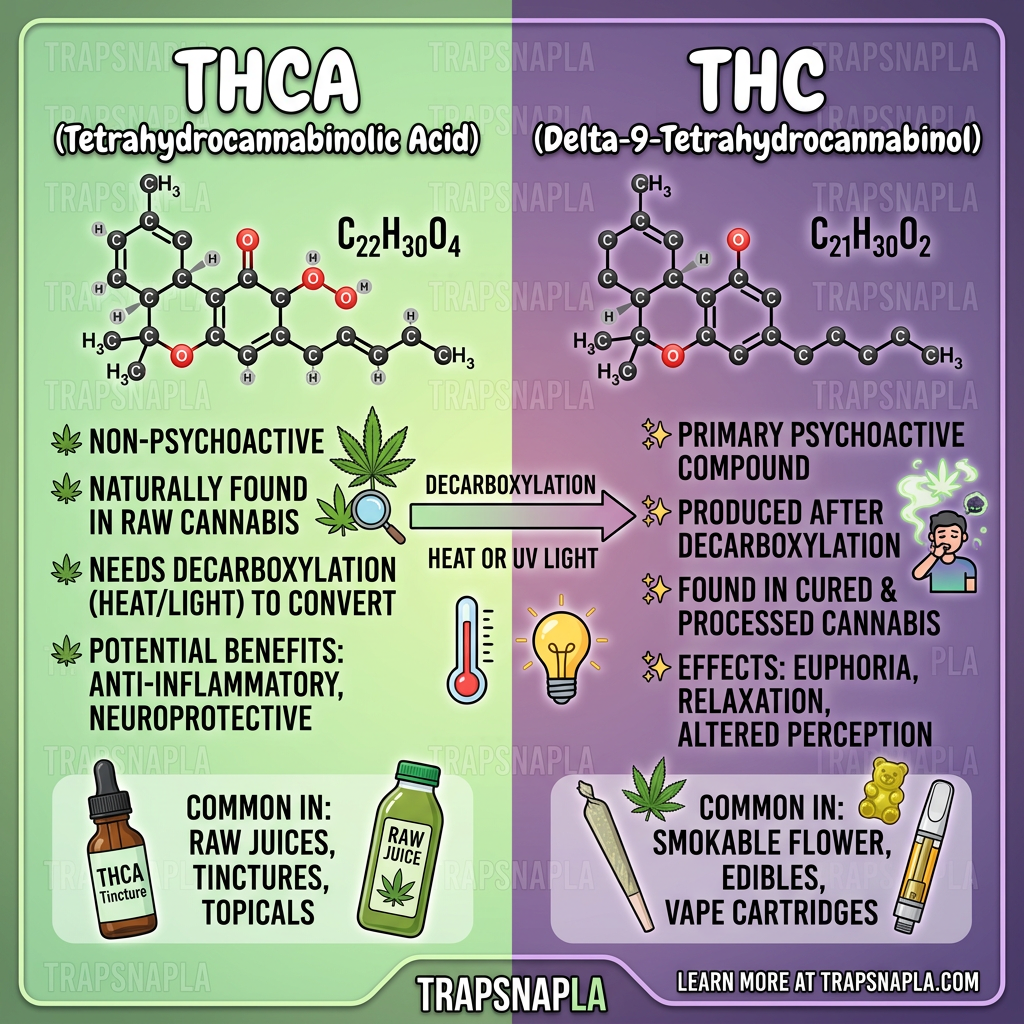
THCA and THC are related, but they are not interchangeable. THCA is an acidic cannabinoid found in raw cannabis. THC, usually meaning delta-9 THC, is the compound most associated with the familiar weed high. Heat can convert THCA into THC, which explains why a flower label showing relatively little delta-9 THC can still describe material that becomes intoxicating when heated.
That missing detail causes a lot of confusion. Someone reads a small THC number, sees a much larger THCA number, and assumes the second one does not count. The chemistry has other plans. Understanding the difference between THCA and THC means separating what is in a sample before heating from what that sample can become. It also means keeping chemistry, product labeling, and legal claims in separate conversations.
What THCA actually is
THCA stands for tetrahydrocannabinolic acid. Its structure includes a carboxyl group that THC does not have. That small structural difference changes how the molecule behaves. THCA is generally described as non-intoxicating in its unheated form; that does not establish that every THCA-containing product is harmless or completely free of THC.
Cannabis contains multiple cannabinoids, and their proportions vary. A cannabinoid report may list THCA, delta-9 THC, CBD, CBDA, and other compounds separately. Those rows are measurements, not competing names for the same substance. Coated-flower labels add another layer; our guide to moon rocks and snow caps explains those format names. Reading only the row with the most familiar abbreviation can leave out much of the picture.
Research on unheated THCA is also much less developed than research on THC. An interesting laboratory finding is not enough to establish a treatment for pain, inflammation, or another medical condition. A product label cannot close that evidence gap by printing the word wellness.
Why heating changes the answer
The conversion from THCA to THC is called decarboxylation. At a basic chemistry level, the molecule loses carbon dioxide. Heat promotes that change; changes can also occur more slowly during storage. This is a description of the chemistry, not a preparation guide. [1]
The practical point is that a certificate of analysis describes a sample under particular testing conditions. It does not necessarily describe the exact chemical mixture after that material has been heated. Asking whether THCA can get someone high therefore requires another question: are we talking about the unheated compound or a product after conversion?
A claim such as “contains almost no THC” can be technically narrow while leaving readers with the wrong impression. If substantial THCA is present, looking at delta-9 THC alone is an incomplete way to assess potential intoxication. The large number does not disappear because it lives on a different line.
Understanding total THC
Reports may include a calculated value called total THC or potential total THC. A commonly used calculation combines measured delta-9 THC with THCA adjusted for the mass lost during conversion. The familiar factor is approximately 0.877. Laboratories and regulatory programs specify how results must be calculated and reported; readers should check the report’s own definitions. [2]
For a purely illustrative example, a sample with 20 percent THCA and 1 percent delta-9 THC would calculate to approximately 18.54 percent potential total THC using that factor. This is label arithmetic, not a prediction of how much THC a person absorbs or a recommendation about consumption.
Actual exposure also depends on the amount involved, the route of exposure, conversion, losses, and individual circumstances. Potential total THC is useful for interpreting composition. It is not a precise personal effects calculator, and it should never be presented as one.
Why the units matter
Percent, milligrams per gram, and milligrams per package answer different questions. A percentage describes a proportion. A package total describes the amount in the entire container. Without the unit, a number such as 20 is not especially informative.
One percent by weight corresponds to 10 milligrams per gram. That conversion helps explain why two reports can describe the same concentration with different-looking numbers. It does not make a flower result equivalent to an edible serving. The substance being measured, the product format, and the reporting basis still matter.
Also check whether the result is reported on a dry-weight basis. Moisture affects the denominator used for a percentage. Comparing differently reported samples as though every measurement used identical conditions can create misleading conclusions. The footnotes are doing real work here, even if the packaging makes them look optional.
A report needs to match the product
A useful report identifies the sample, batch or lot, laboratory, relevant dates, and tests performed. A QR code is only a route to information; it is not proof that the information matches what is in front of you. Compare the identifiers rather than stopping at the first PDF that opens.
Look beyond potency. A cannabinoid panel tells you which cannabinoids were measured. It does not automatically mean the sample was evaluated for pesticides, heavy metals, microbes, or residual solvents. California’s testing program illustrates how these are separate testing categories. Requirements differ elsewhere. [2]
If the batch does not match, the document is evidence about another sample. If testing is missing, that is an unknown. Neither situation becomes more reassuring because the report has a professional logo or a long string of decimal places.
Chemistry does not settle legality or safety
The phrase THCA flower is not a universal legal category with identical rules everywhere. Jurisdictions can differ in how they define hemp, calculate THC, regulate finished products, and treat possession or transport. This article does not provide a current legal determination. Check the relevant government authority for the location and date that matter.
Safety is another separate issue. Converting THCA into THC introduces the risks associated with THC exposure, including impairment. Unheated material can have other concerns, including contamination. Being plant-derived does not exempt something from chemistry or biology.
Medical claims deserve particular care. Evidence for a specific approved cannabinoid medicine cannot simply be transferred to an untested THCA product. The NIH’s overview distinguishes cannabis research from evidence supporting particular medicines and conditions. [3]
Common questions about THCA and THC
Is THCA the same as delta 9 THC
No. They are distinct molecules with a precursor relationship. Heating can convert THCA into delta-9 THC. That relationship is why a low delta-9 result before heating does not necessarily indicate low intoxicating potential afterward. Read the full cannabinoid profile and how total THC is defined.
Does a high THCA number prove quality
No. It describes one part of chemical composition. It does not establish cleanliness, accurate labeling, clinical benefit, or a predictable experience. A quality claim would need more evidence than a potency number, including relevant testing and traceability to the actual batch.
Can a THCA product guarantee a negative drug test
No such guarantee should be assumed. Products may contain THC, and heating can create it from THCA. A product’s marketing category is not a reliable promise about a biological test result. Testing rules and methods also vary, so avoid treating packaging language as professional testing advice.
Is unheated THCA a proven medicine
Research interest is not the same as an established treatment. Human evidence, formulation, dose, outcomes, and adverse effects all matter. Anyone considering cannabinoids for a medical concern should discuss that concern with a qualified clinician rather than using a label abbreviation as a treatment plan.
The useful distinction is straightforward: THCA describes a particular compound, while THC describes another. Their relationship explains why a label needs context. Once you understand conversion, units, and batch matching, the abbreviations become much less mysterious.
Sources
1. Milay and colleagues — Cannabis chemistry during storage.
2. California Department of Cannabis Control — Testing laboratories.
3. NIH NCCIH — Cannabis and cannabinoids evidence overview.
Related Trap Snap LA guides
- Delta-8 vs Delta-9 THC: differences and risks
- Indica vs Sativa vs Hybrid: what the labels really mean
- THC percentage explained: potency is not quality
- Why edibles take longer to kick in
More questions about THCA and THC
Are THCA and CBDA the same thing?
No. THCA and CBDA are different acidic cannabinoids. Heating can form THC from THCA and CBD from CBDA; these are separate chemical changes. The 2020 postharvest study measured them separately.
Is THCA the same as delta-8 THC?
No. THCA is an acidic cannabinoid; delta-8 is an intoxicating form of THC. NIST describes THCA conversion, while the FDA identifies delta-8 THC as a distinct cannabinoid.
Is the THC measured in urine the same as THCA on a flower label?
No. SAMHSA identifies the federal urine-test analyte as THC carboxylic acid, a metabolite. A flower label’s THCA means tetrahydrocannabinolic acid. Similar abbreviations do not make the urine analyte and plant ingredient identical.
Tags: THCA vs CBDA explained; THCA flower label vs urine THC test



Trap Snap LA editorial note: A chemical name does not fully describe the finished product. Our flower versus pre-roll guide explains how fillings, additions, and the final tested item can change the labeling question.