
Indica vs Sativa vs Hybrid: What Labels Really Mean

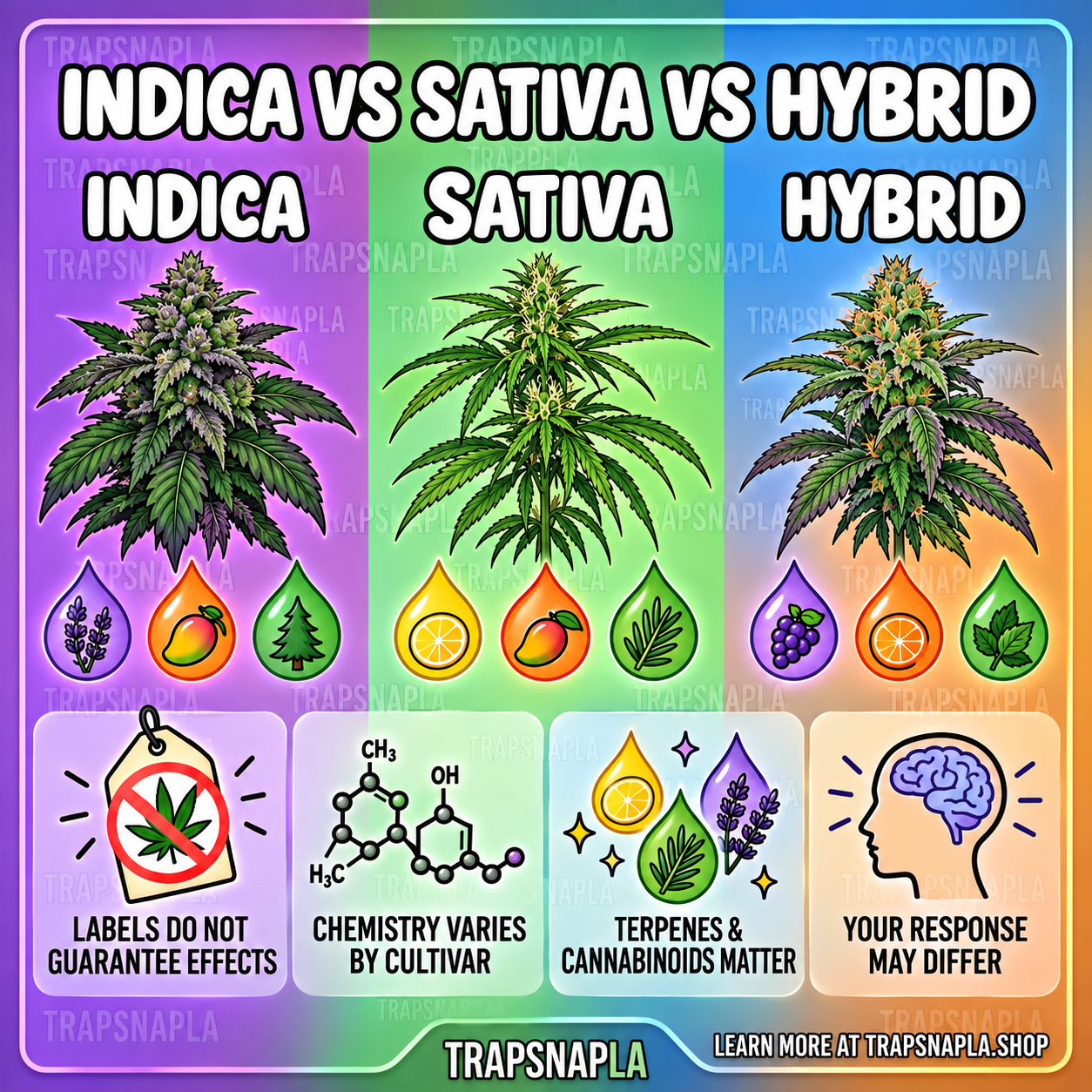
Indica for the couch. Sativa for getting things done. Hybrid for somewhere in the middle. If you’ve spent five minutes around cannabis content, you’ve probably seen that explanation.
It’s memorable. It’s also a lot more confident than the evidence deserves.
The labels in an indica vs sativa vs hybrid comparison can tell you how a product is being described, but they can’t reliably predict exactly how someone will feel. The actual chemistry, the amount of THC, the product format, and the person all matter. So let’s unpack the labels without turning this into a botany lecture.
Why these labels became so familiar
The words indica and sativa have roots in the way cannabis plants have been classified and described. Over time, they also became shopping categories and shorthand for expected effects.
That’s where the confusion starts. A description of a plant’s background or appearance isn’t the same thing as a tested forecast of its effects on a particular person. The same word can end up doing two jobs, and one of those jobs is much harder to defend.
When someone says “indica makes you sleepy,” they might be repeating a personal experience, a label, or something they heard. Those are different kinds of information, even when they all fit into the same sentence.
For more context on why a single number or label cannot predict the full experience, see our THC percentage guide.
What hybrid actually means
Hybrid generally points to mixed ancestry rather than a neat, separate category with a guaranteed feeling. Modern cannabis has a lot of mixed breeding behind it, which makes a clean two-team split difficult.
You may see a product described as “70 percent indica.” That doesn’t mean it contains 70 percent of a measured relaxing ingredient. It’s also not a THC percentage. Unless the producer explains how the description was determined, it should not be read like a precise lab result.
“Balanced hybrid” has the same limitation. It might communicate a brand’s intended description, but it doesn’t promise a perfectly balanced experience. People aren’t sliders you can set halfway between sleepy and energetic.
What researchers found when they checked
A study by Watts and colleagues compared indica and sativa labeling with genetic and chemical information. The labels didn’t neatly separate the samples into distinct genetic groups. Some associations with particular terpene patterns showed up, but that’s very different from confirming a universal effects chart. [1]
In everyday terms, the categories weren’t as tidy as the packaging made them look. A label could connect with certain features without describing everything about the plant or predicting a person’s response.
That doesn’t mean every use of the words is meaningless. It means the labels deserve less weight than they often get. They’re a rough description, not a remote control for your mood.
Start with what is actually in the product
Cannabinoids such as THC and CBD are a more direct part of the conversation than an indica or sativa tag. They still don’t explain everything, but they describe measurable ingredients rather than a general category.
Even here, avoid shortcuts. A higher THC percentage isn’t a higher quality score. A product containing CBD isn’t automatically protected against unwanted THC effects. A controlled trial found that adding CBD at the tested ratios didn’t reliably prevent the acute adverse effects researchers measured. [2]
The better question is not “Which label always feels better?” It is “What does this label actually tell me?” Once you ask that, a lot of confident marketing starts sounding a little less scientific.
Terpenes add detail but not certainty
Terpenes are compounds that contribute to cannabis aroma. They help explain why one sample smells citrusy while another smells earthy, floral, or sharp. That’s genuinely useful information about the product.
The leap happens when an aroma description turns into a promise about mood. A product containing a particular terpene isn’t guaranteed to make someone focused, relaxed, social, or sleepy. Research into specific combinations is still more limited than the simple charts suggest.
It’s reasonable to notice or prefer a smell. It’s a different claim to say that smell proves a predictable effect. Keeping those two ideas separate lets you enjoy a clear description without treating it like a medical forecast.
Why two friends can disagree about the same strain
One person says a product felt relaxing. Their friend says it made their thoughts race. Neither experience automatically cancels out the other.
People differ in sensitivity, previous exposure, and how their bodies process THC. The amount and route matter, too. Stress, surroundings, and expectations can also shape what an experience feels like. The NIH overview describes cannabis effects and risks as more complicated than a single strain label. [3]
This is why “my friend swears by it” isn’t the same as a reliable prediction. A personal story may be honest and still be a poor match for someone else. The missing context is doing a lot of work.
The same name does not guarantee the same batch
A strain name can feel like a fixed recipe. In practice, the name alone doesn’t prove that two batches have identical cannabinoid or terpene profiles.
Growing conditions, handling, and differences between producers can complicate the picture. Even when the label stays familiar, the report for the actual batch is more relevant than a generic description copied onto a product page.
Think of the name as a starting point for identification, not the entire specification. If two packages share a strain name but show different measured contents, the numbers are telling you something the name cannot. There’s no need to force them into an identical experience just because the branding matches.
What to do with effect descriptions
Words such as “uplifting,” “calming,” and “creative” can sound pleasantly specific. They’re often descriptions of expected or reported experiences, not outcomes demonstrated for that exact product in a controlled study.
A useful description should make that distinction clear. “Some people report feeling relaxed” is more honest than “this causes relaxation in everyone.” The first leaves room for variation. The second makes a promise it can’t support.
The same caution applies to daytime and nighttime labels. They don’t establish that someone can drive, work safely, or concentrate normally after using the product. A suggested time of day isn’t evidence that impairment has disappeared.
A simpler way to read the category
When you see indica, sativa, or hybrid, take it as one piece of context. Then separate the other information into its own questions: What cannabinoids are listed? What amounts are reported? What format is it? Does the batch information match?
Keep personal stories in another category. They can describe what someone noticed, but they can’t replace ingredient details or research. And keep health claims in a stricter category still, where an appealing name isn’t enough evidence.
You don’t need to memorize a whole new system. The goal is just to stop asking one broad label to answer five different questions. That alone makes the information less confusing.
The takeaway without the three box chart
Indica, sativa, and hybrid are familiar cannabis labels, but they aren’t dependable instructions for how your brain will respond. The popular “sleepy versus energetic” explanation is much cleaner than the real-world evidence.
Actual ingredients, product format, amount, and individual differences give the conversation more substance. Even with those details, nobody can promise an identical experience across different people. [3]
So there’s no need to pretend the labels don’t exist. Just give them the right-sized role. They can introduce a product. They should not get to make every claim about it.
Sources
- Watts and colleagues — Cannabis labeling and genetic variation.
- Englund and colleagues — CBD and acute THC effects in a randomized trial.
- NIH NCCIH — Cannabis and cannabinoids.
Questions about indica, sativa and hybrid labels
What is a cannabis chemotype?
A chemotype describes chemical composition, such as a THC-rich or CBD-rich profile. It answers a different question from a strain name or ancestry description. Researchers classify study material by cannabinoid chemistry.
Does indica mean high CBD?
No. “Indica” is not a measured CBD result. The Watts study compared commercial indica/sativa labeling with genetic and chemical data; use a cannabinoid analysis to establish CBD content.
Does hybrid cannabis mean genetically engineered cannabis?
The label alone does not establish genetic engineering. NHGRI defines genetic engineering as directly changing DNA with laboratory technologies. An ancestry description does not document that process; this distinction does not authenticate a specific cultivar.
Tags: cannabis chemotype vs strain name; does indica mean high CBD



Trap Snap LA editorial note: Category labels should stay separate from personal response predictions. Our article on different responses to the same THC amount adds context beyond the strain name.