
Hollywood’s Fake Weed Department

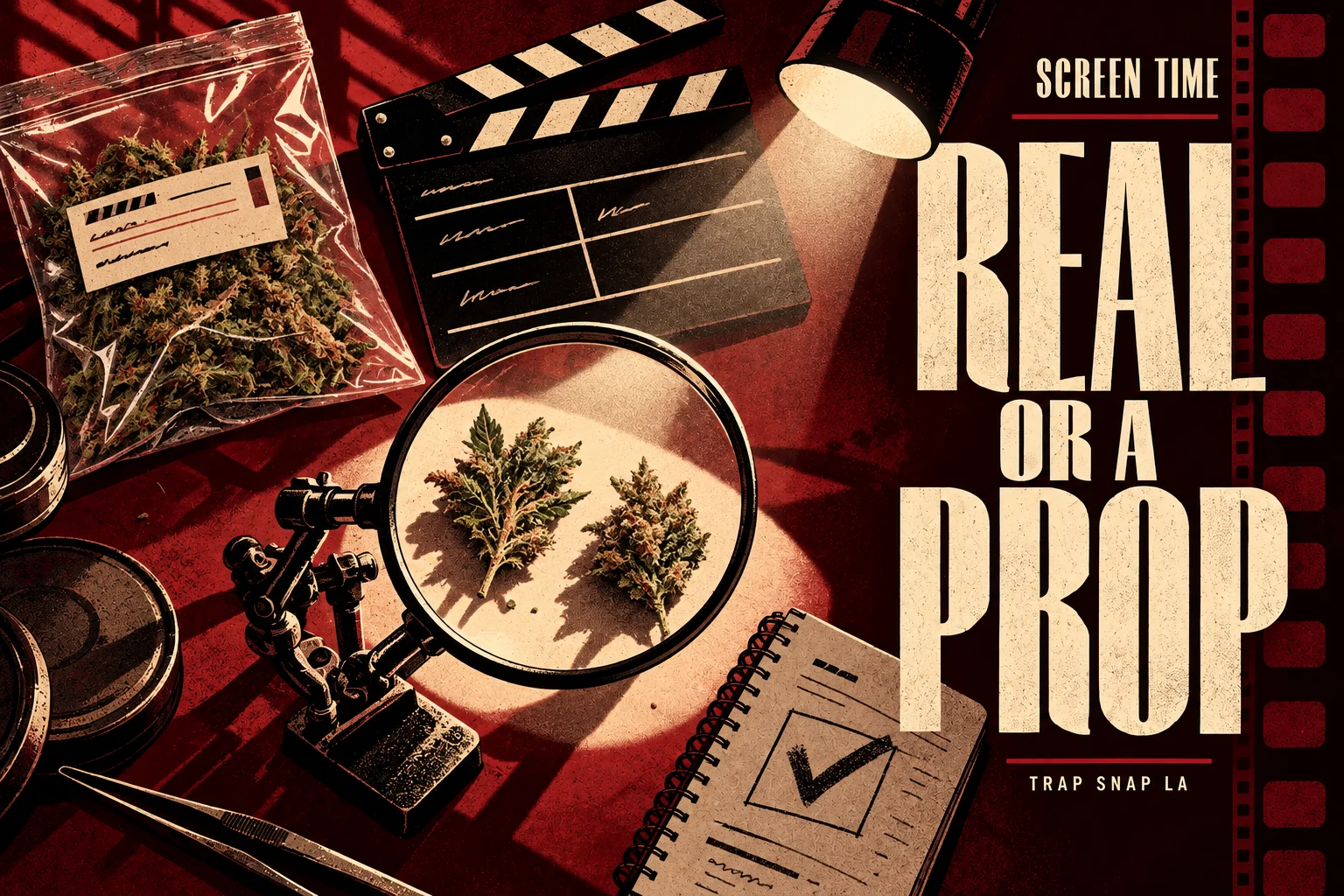
Screen Time · Episode 5 of 7
A scene using fake weed in movies can look casual: two characters talk, a prop changes hands, smoke appears, and the edit moves on. Behind that easy-looking moment is a practical question. What did the production actually put in front of the camera?
Fake weed in movies is a real prop conversation, but it does not have one universal answer. A screen image establishes an appearance. A documented production account can establish more. Guessing what was used because a performer looks convincing skips the evidence in between.

The screen and the set are different worlds
An actor performs a character. A prop represents an object in that character’s world. Those two relationships do not establish that the object has the real-world contents the story gives it.
Audiences already understand that principle with other film objects. A threatening package in a thriller does not need to contain the fictional substance. A meaningful document can be created for the scene. The image and the story tell viewers how to interpret it.
Cannabis props deserve the same distinction. A close-up can make an object legible to the audience without functioning as an ingredient disclosure, a chemical analysis, or proof of a performer’s private habits.
Hear the on-set story
Seth Rogen, Keke Palmer and Keanu Reeves on WIRED — The fake-weed conversation arrives inside a much bigger, very funny interview. The three of them keep taking each other off script.
There are performers on the record
In a September 2025 WIRED interview, Keke Palmer recalls using real cannabis with Seth Rogen for a scene after finding the substitute strange. Their story quickly turns to the problem of repeated takes: by the end, Palmer says she was confused about what was happening. It is a specific behind-the-scenes account, with the awkward production complication left in.
It does not identify the contents of every prop in every Rogen film. A performer’s account of one experience remains an account of that experience. Turning it into all Hollywood uses the same thing would add a claim the interview did not supply.
This is a useful difference between behind-the-scenes reporting and celebrity speculation. The reporting identifies what someone actually said, where, and in what context. The speculation treats a public persona as evidence for unrelated scenes.
Prop suppliers describe a range of substitutes
Film-prop supplier Honeyrose describes herbal materials used to stand in for tobacco or cannabis in productions, as well as versions designed without identifying logos. Those are the supplier’s product descriptions, not an independent account of every listed film.
The narrow point is that substitute materials and presentation choices exist. A supplier’s general project list cannot establish which material appeared in a specific cannabis scene. Nor does the word herbal establish that inhaling a material is harmless.
This article concerns screen representation, rather than recipes, substitutes for personal use, or a tutorial for recreating a scene. The underlying research reference is the supplier’s film-and-theatre description, not a recommendation or purchase link.
Continuity is the quiet complication
A scene can be built from multiple angles and separate performances. The audience receives one continuous moment; the production has to maintain enough consistency for the pieces to fit.
Consider an explicitly hypothetical handled prop. Its position, appearance, and the moment it changes hands could differ between takes. If the edit combines those takes, a change can become visible even when the actor’s delivery is excellent.
That is why a seemingly minor object can become a continuity concern. The job is not only to look recognizable in a still photograph. The object has to make sense across time as the scene is assembled.
Realism is a construction, not a chemical result
Performance, framing, editing, and sound can make an invented screen moment feel natural. The audience’s confidence that a scene looks real is therefore an artistic response, not a test of the material used in it.
The same reasoning helps outside film. An attractive photo or convincing label can communicate identity without proving contents or origin. Our guide to checking cannabis claims explains how an image and a material claim need different kinds of support.
For the broader conventions in cannabis movies, see our Hollywood overview. For the related question of public celebrity identity versus documented involvement, read our founder-and-partner guide.
The interesting reveal is not that every movie uses one secret mixture. It is that a convincing scene can be built from several distinct jobs, and identifying the material requires an actual production source. The prop department’s work is making the story readable, not turning the image into laboratory evidence.
Sources
- WIRED, 2025: recorded interview with Seth Rogen, Keke Palmer, and Keanu Reeves
- Honeyrose: film and theatre prop-material descriptions
Series cover: original AI-assisted editorial illustration for Trap Snap LA. Photographs carry their own credits.
More questions about Hollywood cannabis prop materials
Do herbal prop cigarettes contain nicotine?
Not necessarily. Honeyrose labels several film cigarette formats tobacco and nicotine free. That is a supplier description of those formats, not a guarantee about every prop or a claim that inhaling smoke is harmless. The supplier’s film-prop descriptions.
Are all parts of a prop cigar automatically tobacco free?
No. Honeyrose describes a herbal-cigar filler as tobacco free while stating that its wrapper is tobacco leaf. Read the description of each part instead of extending one filler claim to the whole object. The cigar’s material description.
Why did Seth Rogen say not to use real weed on set?
In the WIRED interview, he treated their experience as a reason real cannabis complicates filming. That is a directly recorded reaction to the specific story, rather than proof of a rule on every production. The interview transcript.
Why do some film prop cigarettes have no logo?
Honeyrose explicitly describes unbranded formats, including one suited to period productions. The supplier’s account shows that screen appearance and historical styling can be design requirements separate from the represented material. The unbranded format descriptions.
Tags: Hollywood cannabis props and actor accounts, fake weed movie props versus real contents


