
The Dude’s Apartment Deserves Its Own Story

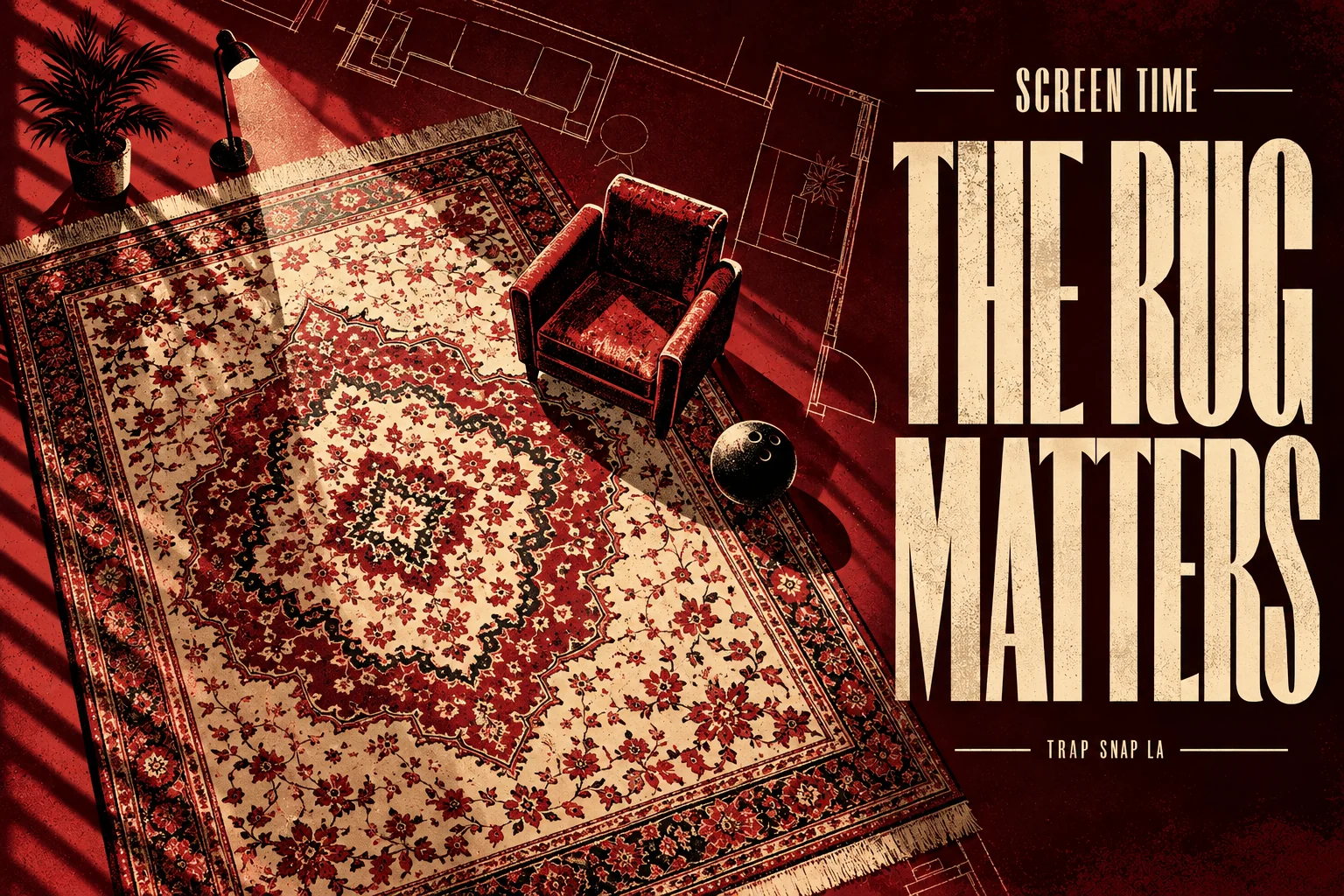
Screen Time · Episode 2 of 7
The Dude does not begin The Big Lebowski with a grand plan. He wants his own space left alone. Then the rug gets ruined, and an ordinary room becomes the reason a very unordinary story starts.
The Dude’s apartment in The Big Lebowski is worth discussing as production design because the film does not need a wall full of explanatory signs to tell us who belongs where. The Dude’s apartment, the places he gets pulled into, and the bowling world all contribute to the contrast.

The rug gives the room a plot
Universal’s official synopsis identifies the destroyed rug and mistaken identity as the start of the Dude’s quest for restitution. The studio also includes a rug-centered clip in its official gallery.
As a narrative device, the rug is excellent because the audience can grasp the complaint immediately. Somebody interfered with his home. He wants the interference repaired. That small, comprehensible demand survives even as the surrounding explanations become increasingly tangled.
The object gives a personal scale to the story. A plot involving money, threats, and confusion can drift into abstraction; a ruined possession keeps returning the problem to something concrete. You do not need to share the Dude’s lifestyle to understand why he cares.
Back to the Dude’s living room
Universal’s Big Lebowski clip gallery — Find “That Rug Really Tied the Room Together,” then wander into the behind-the-scenes clips. The room has almost as much personality as the Dude.
A lived-in space tells a different story from a display room
The apartment can be read as a space organized around its occupant’s habits rather than a performance of importance. It does not need to persuade every visitor that the resident has achieved an impressive social position.
That reading creates a contrast with the more formal, imposing environments the Dude enters. A room can advertise status through scale, arrangement, and what it puts on display. Another can reveal a person mainly through how comfortably they occupy it.
These are visual interpretations of the film, not statements about the production team’s private intentions. The distinction matters: a viewer can analyze what a setting communicates without claiming an undocumented meeting decided it for exactly that reason.
The person and the room belong in one composition
Clothes, posture, furnishings, and framing all participate in the same image. A relaxed character can look at home in one space and noticeably out of place in another. The joke sometimes happens before a line lands, simply because the person and the environment disagree.
This is part of what makes the Dude recognizable as a screen character rather than a collection of cannabis references. His relationship to a room tells us how he handles demands, formality, and interruptions.
Our movie-culture overview looks at familiar stereotypes. The more useful design question is what a particular film adds beyond that shorthand. A specific room and a specific grievance provide more character than the label stoner alone.
Bowling supplies another kind of order
The bowling setting gives the film a repeated social space. It provides a place for familiar companions, arguments, routines, and interruptions to return. That repetition helps the audience recognize a baseline even when the rest of the plot grows stranger.
A recurring location is more than a backdrop. In Focus Features’ location feature, Robert Graf recalls looking for a bowling alley with a retro appearance, manual scoring tables and a particular size. That first-person account gives the film’s bowling-world design a documented practical starting point. It can function as a kind of punctuation, giving a story a place to land between complications. When the same characters return, differences in mood or behavior become easier to notice.
The apartment and the bowling world serve different roles in that pattern. One makes a personal disruption matter. The other makes the Dude’s social world recognizable. Both help ground an adventure that is otherwise happy to wander.
Objects carry meaning without explaining themselves
The rug is not interesting because the audience receives an exhaustive history of its fibers. It matters because the story attaches a relationship to it. The ruined room gives the Dude a reason to act that feels proportionate to his character.
That is a useful introduction to film design: an object can be visible, functional, and meaningful at once. It can belong to the room, enable an action, and reveal something about the person who notices it.
The film’s comedy comes partly from the mismatch between the Dude’s modest concern and everyone else’s larger agenda. The room helps establish that mismatch. For another perspective on how visual shorthand travels into culture, see our design-and-identity article.
The apartment deserves its own story because the movie’s larger story starts there. What looks like a joke about interior decoration is also a lesson in how an ordinary object can give a complicated film a clear emotional center.
Sources
Series cover: original AI-assisted editorial illustration for Trap Snap LA. Photographs carry their own credits.
Questions about The Dude's apartment and The Big Lebowski
Where is The Dude's apartment in The Big Lebowski?
The film places his bungalow in Venice, Los Angeles. Focus Features identifies Venice as the setting and distinguishes it from the wealthy Lebowski’s Beverly Hills environment. Focus Features location feature.
Who was the production designer on The Big Lebowski?
Rick Heinrichs was the production designer. Focus Features quotes him discussing the Sheats–Goldstein Residence used for Jackie Treehorn’s home. Focus Features production-design account.
What bowling alley was used in The Big Lebowski?
Hollywood Star Lanes at 5227 Santa Monica Boulevard was used. Focus Features reports that the building was demolished in 2002, so it should be treated as a historical filming location. Focus Features filming-location history.
Who plays The Dude in The Big Lebowski?
Jeff Bridges plays Jeffrey “The Dude” Lebowski. The film was released in 1998; the studio’s credited runtime is 1 hour 59 minutes. Universal film credits.
Tags: The Dude apartment filming location; Big Lebowski bowling alley production design.


