THC and CBD together and what the research actually says

“THC gets you high, and CBD balances it out.” That's a common explanation, and it sounds reassuringly simple. It's also too simple to rely on.
For the broader theory behind combined compounds, see our guide to the entourage effect and its evidence. Our THCA versus THC guide explains another cannabinoid distinction that labels often compress.
THC and CBD are different cannabinoids, and researchers are studying how they interact. But CBD isn't a guaranteed off switch for THC. Adding the two together doesn't automatically create a milder, safer, or more predictable experience. A THC and CBD clinical trial is easier to interpret when the participant count, crossover design, and other study medicines remain visible.
The useful question isn't whether the ingredients can interact at all. It's what happened with which amounts, in which format, and for which outcome. That sounds like a lot, but the basics are easier to follow than the marketing makes them seem.
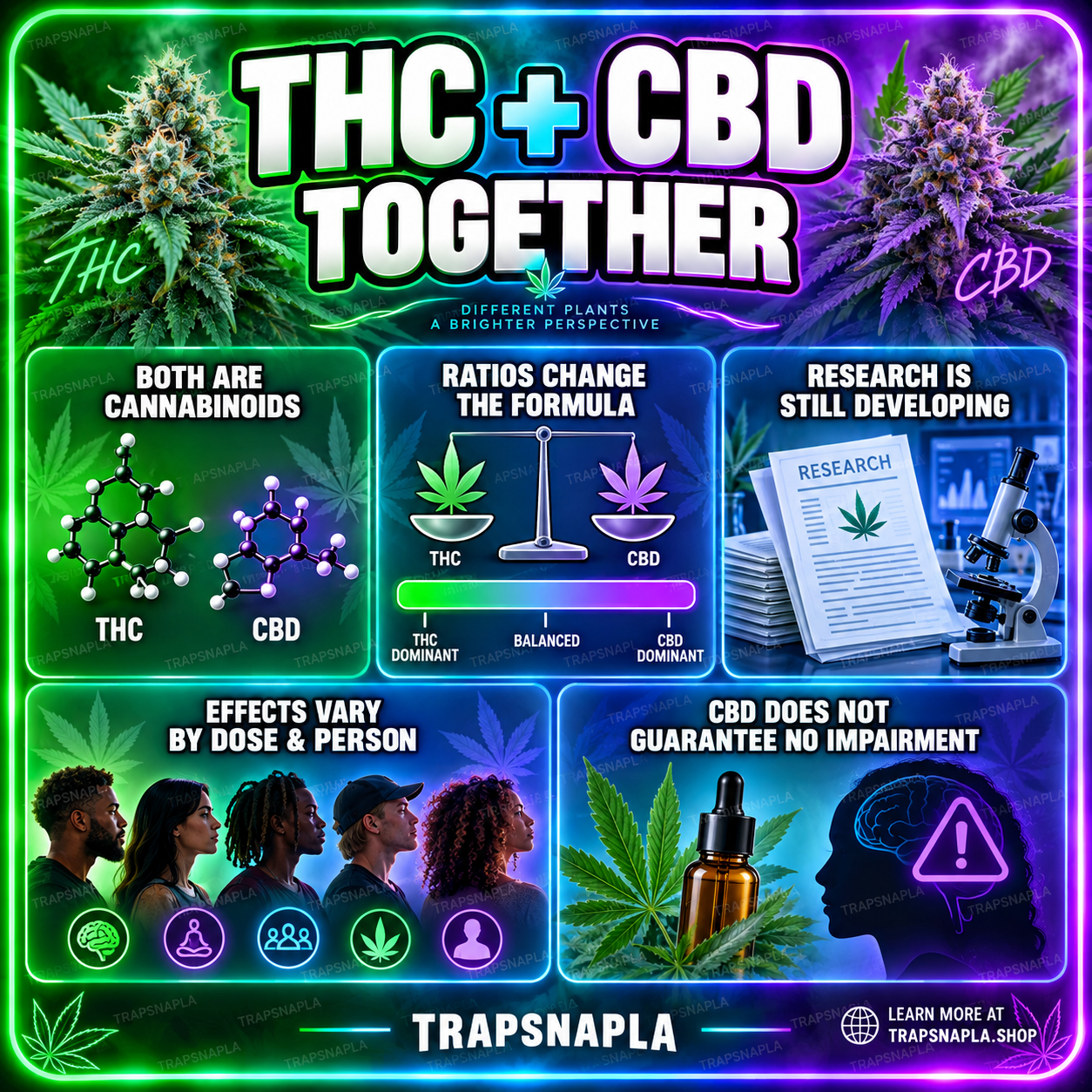
What THC and CBD have in common
Both are compounds found in cannabis. They belong to the broad group called cannabinoids, but sharing a category doesn't mean they behave identically.
THC is responsible for much of the familiar intoxicating effect associated with cannabis. CBD doesn't produce that same typical THC high. Still, “not intoxicating in the same way” doesn't mean inactive, free of side effects, or unable to interact with medications. [1]
That distinction matters because CBD sometimes gets described as if it's simply the harmless opposite of THC. Biology isn't a light switch with THC on one side and CBD on the other. They're separate compounds with their own effects and limitations.
Why people expect CBD to balance THC
The idea is appealing: one ingredient causes an unwanted effect, and another smooths it out. Some people also report that products containing both feel different from products they describe as THC-only.
Those reports can be sincere without proving exactly what caused the difference. The products may have differed in THC amount, other ingredients, timing, or route. Expectations and individual responses may also have played a role.
Controlled studies help separate those variables. They don't answer every possible question at once, but they can test whether a specific CBD and THC combination changes a specific outcome. That's a more precise question than “Does CBD make cannabis better?”
What one controlled inhalation trial found
In a randomized trial, researchers tested several CBD-to-THC ratios in healthy adults who used cannabis infrequently. The participants inhaled defined preparations so the researchers could compare the effects under controlled conditions. [2]
At the ratios tested, adding CBD didn't provide the expected protection against the acute adverse effects the study measured. That included findings relevant to cognition and other responses to THC.
The careful takeaway is not “CBD never does anything.” It's that this study didn't support treating those common ratios as a reliable protective buffer. A balanced-sounding ratio on a package should not be mistaken for evidence that unwanted THC effects have been canceled.
Oral combinations can behave differently
A separate randomized trial examined orally administered THC with and without a high amount of CBD. Under those study conditions, adding CBD increased THC exposure and some adverse effects rather than reliably softening them. [3]
That matters because it challenges the idea that more CBD always means less THC impact. The route and amounts can change the interaction.
It doesn't mean every product containing both will produce the same result. The study tested a particular formulation and situation. Its value is showing why a universal “CBD cancels THC” rule isn't dependable. The relationship is more complicated than two ingredients pulling in opposite directions.
A ratio does not tell you the whole amount
A ratio describes proportions. A 1-to-1 ratio means equal amounts of the two named ingredients, assuming the label clearly identifies them.
For a made-up math example, one milligram of each and ten milligrams of each both have a 1-to-1 ratio. The proportions match, but the total amounts do not. This is an illustration of label math, not a suggested serving.
Also check the order. CBD-to-THC and THC-to-CBD reverse what the first number refers to. If the package only prints two numbers without naming the order, the ratio is incomplete information. A tidy symbol can't replace a clear explanation of the ingredients and amounts.
Balanced is a description not a safety rating
“Balanced” often suggests a relationship between cannabinoid amounts. It can sound like a promise of a balanced experience, but those aren't the same claim.
A product can contain similar amounts of THC and CBD and still cause intoxication or unwanted effects. Individual sensitivity, route, and the actual amounts remain relevant. The presence of CBD doesn't erase the THC from the package.
This is especially important if someone assumes that a balanced label makes driving acceptable or prevents anxiety. Those conclusions need evidence about the actual outcome. An ingredient ratio can't provide a blanket clearance for activities requiring unimpaired judgment and coordination.
Different outcomes need different evidence
A study might measure anxiety, memory, heart rate, sleep, pain, or blood concentrations. Finding a change in one of those doesn't automatically establish a benefit in all the others.
Likewise, a result in a particular group of healthy participants may not apply unchanged to someone with a medical condition or taking medication. Timing and route can also affect what the result means.
When reading a headline, ask what “worked” actually refers to. Did participants report a different feeling? Did a test score change? Was a health condition treated? Those are different claims. Keeping the outcome specific helps you avoid stretching a study beyond the question it answered.
Medication questions deserve individual advice
CBD and THC can be relevant to medication interactions. The NIH overview discusses side effects and interactions rather than treating plant origin as proof of harmlessness. [1]
If someone takes prescribed or over-the-counter medication, a pharmacist or clinician can help assess the specific combination. Bring the ingredient information rather than relying only on a brand name or the word “hemp.”
Don't stop a prescribed medicine or change its amount based on a general article. The point is to get advice that accounts for the actual treatment, the cannabinoid product, and the person's health. A ratio printed on a label doesn't do that assessment for you.
CBD is not an emergency plan
If someone feels unwell after THC, adding CBD isn't a guaranteed way to reverse the situation. The research above gives good reasons not to make that promise. [2, 3]
Move away from immediate hazards, avoid adding more cannabis or other substances, and get appropriate advice. In the United States, Poison Control can help with suspected poisoning at 1-800-222-1222. Severe symptoms such as trouble breathing, collapse, seizures, or inability to wake someone call for 911. [4]
Keep the packaging and approximate timing available. Knowing what was taken is more useful than trying to improvise an ingredient combination after the effects have already become uncomfortable.
What a clear product explanation should include
The label should identify the cannabinoids, their amounts, the serving or package basis, and any ratio order. If it makes a health claim, that claim needs evidence beyond simply containing both THC and CBD.
A useful explanation also separates the product's measured composition from personal stories. Someone may honestly prefer a combination without proving it's safer for everyone or suitable for a particular medical condition.
Finally, distinguish a retail product from a specific approved medicine. Evidence and approval for one defined treatment don't automatically transfer to every item containing a related cannabinoid. The product, formulation, and intended use matter. [1]
The answer without the balancing myth
THC and CBD can interact, but CBD isn't a dependable antidote to THC. Some tested combinations have not reduced the expected adverse effects, and certain oral combinations have increased exposure and unwanted effects under study conditions.
Read ratios as proportions, not promises. Keep the amount, route, and actual outcome in the conversation.
The simple version is this: “contains CBD” tells you something about the ingredients. It doesn't tell you that the THC has been switched off.
Sources
1. NIH NCCIH — Cannabis and cannabinoid evidence.
2. Englund and colleagues — Randomized trial of CBD and acute THC effects.
3. Zamarripa and colleagues — Oral THC and CBD combination trial.
4. CDC — Cannabis and poisoning.
Frequently asked questions about reading THC and CBD clinical studies
How many people completed the oral THC and CBD trial?
Eighteen adults completed the trial described here, out of 22 randomized participants. The final sample size is part of the evidence’s scope rather than a guarantee about every person’s response. Zamarripa trial participant flow.
What does crossover mean in a THC and CBD clinical trial?
In this trial, the same participants completed different study conditions in a randomized order. That within-person design differs from comparing a separate group of people for each condition. Zamarripa within-participant crossover design.
Did the oral THC and CBD study include other research medicines?
Yes. All three conditions included a five-drug cytochrome P450 probe cocktail used to investigate drug interactions. That protocol detail belongs in the study’s context; it is not a home-use recipe. Zamarripa trial probe-drug protocol.
What do PK and PD mean in THC and CBD research?
Pharmacokinetics, or PK, concerns drug concentrations over time. Pharmacodynamics, or PD, concerns measured effects. This paper reports both, including blood measurements, subjective ratings, performance tasks, and vital signs. Zamarripa trial PK and PD outcomes.
Tags: THC and CBD crossover clinical trial meaning, oral THC CBD trial sample size and study design