
The Stoner Room Got a Design Makeover

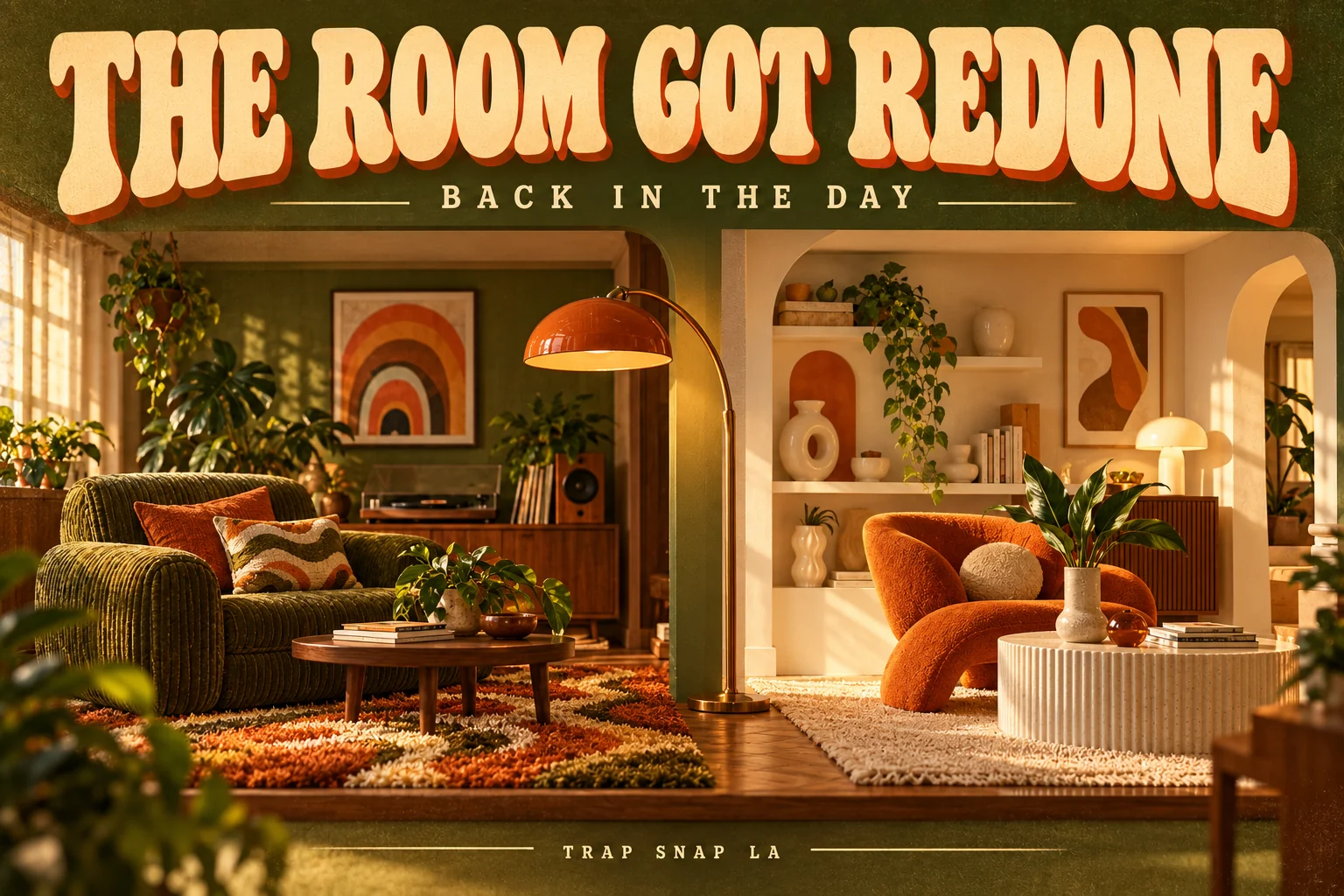
Back in the Day · Episode 4 of 7
Ask somebody to picture a stoner room and they may invent the entire set in two seconds: a couch with history, a poster that has seen better tape and one object nobody can explain. It is a durable screen stereotype. It is also a very small box to put a whole group of adults inside.
Cannabis home decor and design are interesting because the room can tell a different story. Pottery, furniture and graphic design can carry a cultural reference without turning every surface into the same leaf symbol. There is plenty of room between a movie cliché and a showroom where nobody looks allowed to sit down.
A real room gives the subject some texture
Architectural Digest’s April 2022 tour of Houseplant’s Los Angeles headquarters documented a bungalow with midcentury furniture, ceramics connected to Seth Rogen’s pottery and two green chairs from the set of This Is the End. It is one designed workspace, not a representative sample of everybody’s home.
The film chairs are the fun detail. An object can carry a previous life into a new room without announcing the entire backstory. A guest sees furniture; someone who knows the reference sees a tiny piece of movie history.
This is a culture and design case study, not a buying guide or a verdict that a celebrity’s taste should become everybody’s taste. The useful question is how a space makes its interests visible. Does it explain them loudly, hint at them or leave the explanation to whoever recognizes the reference?
Tour the room makeover
Seth Rogen’s Houseplant headquarters tour — Come for the house tour; stay for the ceramics, records and slightly ridiculous design details.
The leaf logo does not have to do every job
A room can signal personality through an unexpected color, an uneven ceramic surface or a carefully chosen shape. The signal does not have to be a literal symbol. Sometimes the object becomes more interesting when it could sit comfortably beside something with no cannabis connection at all.
Think about the difference between an item that announces an identity and one that belongs to a person with that identity. A giant label asks the viewer to read a message. A textured vessel asks the viewer to notice a material. Both can be intentional; they simply start different conversations.
That is an editorial reading of design, not a claim that subtle objects are more authentic. Loud colors can be personal. A joke can be tasteful precisely because the owner knows it is ridiculous. A room does not need an invisible judge awarding points for restraint.
Packaging can borrow the language of a home
MA-MA’s official Houseplant design case, completed in 2021, describes bright color, line illustration, a custom typeface and structural packaging work. The project is useful evidence that cannabis-related design can be discussed through the same visual vocabulary as other household objects.
Boxes, repeated colors and clear lettering can create a recognizable family of shapes. The outside of the package becomes part of the brand’s environment, even before anyone reads a detailed description. That is a design observation, not evidence that a product is safer, better or suited to a particular person.
Our packaging design guide explores how those signals work. Our celebrity brand guide explains why a visible face and a business relationship are separate questions.
A makeover does not mean everyone moved together
It is tempting to narrate design as one clean march from messy to sophisticated. That story makes a tidy headline and a poor map. An expensive-looking room can be impersonal. A beat-up chair can have more meaning than a coordinated collection. People can also enjoy both.
Celebrity spaces are highly visible, so they can make a style seem more widespread than the evidence supports. A published tour tells us what was shown in that room on that occasion. It does not tell us what all cannabis culture looks like or what people should own.
The more interesting angle is how many looks can coexist. A room might lean toward music, local art, hand-built ceramics, retro graphics or almost no visible cultural markers. There is no reason all those adults need the same visual uniform.
For a fun photo story, look at ordinary design details instead of a shopping list: the curve of a handle, the outline of a chair, the way one bright object interrupts a quiet shelf. The subject becomes personal taste, with cannabis culture as one influence rather than the whole personality.
Our old-school and modern culture article gives the broader context. The design conversation adds something smaller and more tangible: what a person chooses to have around them.
Two questions about the makeover
Is there one recognizable cannabis interior style?
No single style represents everyone. The examples here show a specific published workspace and a specific design project, alongside an editorial discussion of varied personal taste.
Does premium-looking design prove product quality?
No. Color, typography, materials and celebrity associations can shape impressions. They do not replace evidence about a product or establish any health or performance claim.
Sources: Architectural Digest’s 2022 headquarters tour; MA-MA’s official Houseplant design case.
Sources
- Architectural Digest: Inside Seth Rogen’s Cannabis Company Headquarters, April 27, 2022
- MA-MA: Houseplant product and packaging case, completed 2021
Series cover: original AI-assisted editorial illustration for Trap Snap LA. Photographs carry their own credits.
More questions about Houseplant interior and packaging design
Who is Seth Rogen’s Houseplant business partner?
Architectural Digest’s 2022 account identifies Evan Goldberg as his business partner. That source documents the featured company workspace and partnership, rather than a general ownership breakdown. The original headquarters tour.
Why do Houseplant tins stack together?
MA-MA says the tins were designed to stack like building blocks and serve as reusable keepsakes. That is the designers’ stated intention, rather than evidence that every owner collects them. MA-MA’s design case.
Who designed the custom Houseplant typeface?
MA-MA’s project credits list Tipografies for typeface design and production, with SMLXL and Principi credited for creative direction. Specific credits tell a clearer design story than assigning every object to the celebrity founder. The project credit list.
Tags: Houseplant office and packaging design, Seth Rogen cannabis design case study


