THC per serving vs per package on edible labels

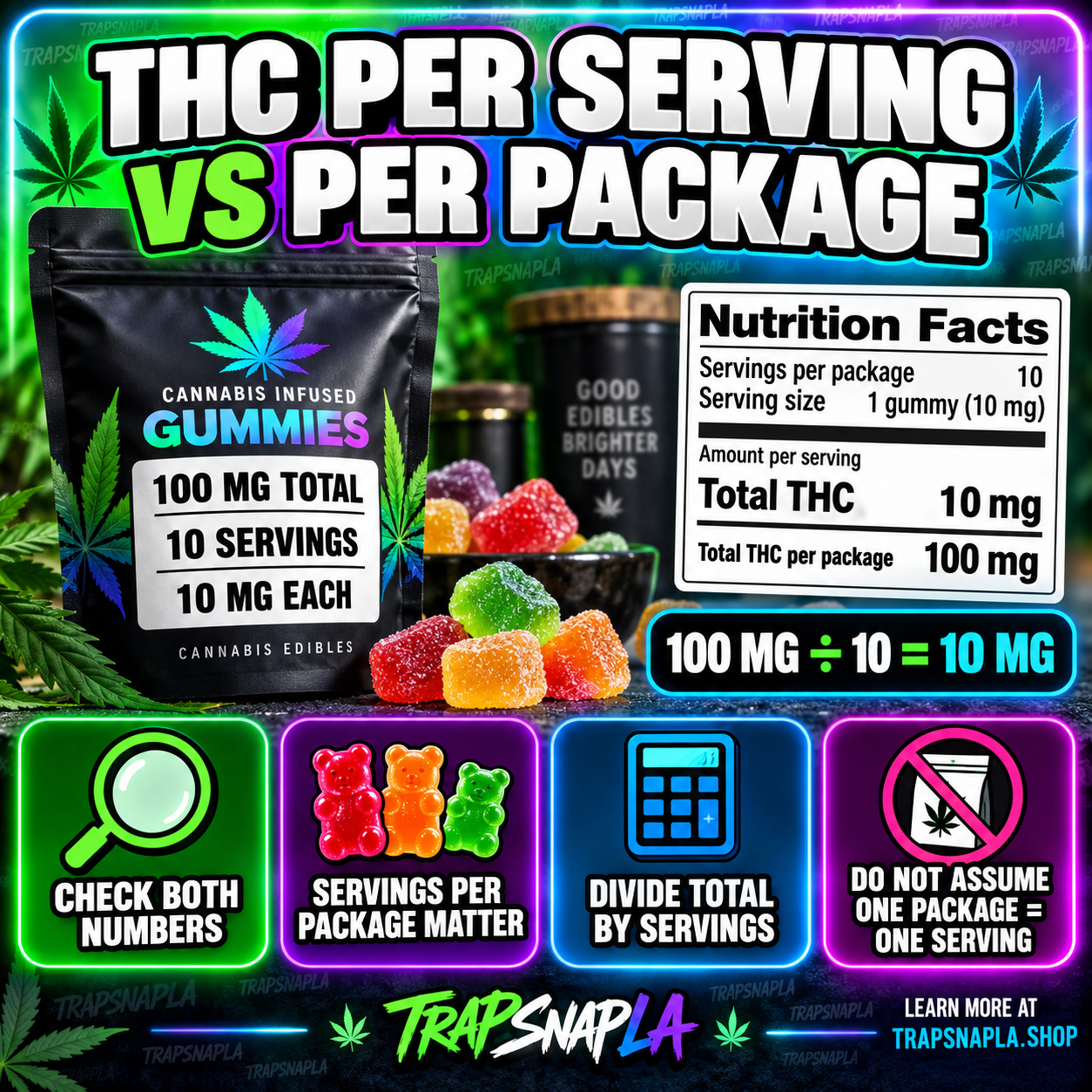
An edible package can show one number on the front, another beside the serving size, and a third in the cannabinoid breakdown. None of those numbers has to be wrong for the label to be easy to misread.
For more context on why timing matters, read why edibles take longer to kick in. Our THC percentage guide explains why a single number does not tell the whole product story.
The main distinction is simple: THC per serving describes a defined portion, while THC per package describes the total in the whole container. One piece of food isn't automatically one serving. California edible labeling requirements also explain why serving and package information should be visible together rather than inferred from the front-panel artwork.
Once you keep those ideas separate, most of the math becomes straightforward. The tricky part is noticing what each number refers to before assuming the entire gummy, cookie, drink, or package is a single portion.
Start with three label fields
Find the serving size, the number of servings in the package, and the THC amount per serving. Then locate the total THC amount per package if it's provided.
These fields work together. A serving size tells you what portion the manufacturer is using for the label. The serving count tells you how many of those portions are included. The per-serving THC figure tells you the amount assigned to each labeled portion.
This is a way to understand the package, not a recommendation about how much someone should consume. A serving printed by a manufacturer isn't a personalized medical assessment or a guarantee of a comfortable experience.
A simple made up example
Imagine a package labeled as containing ten servings, with two milligrams of THC per serving. The package total would be twenty milligrams of THC.
The calculation is simply ten times two. It checks whether the serving information and package total agree. These numbers are only an illustration of label math, not dosing advice.
Now imagine that the package contains five physical pieces. Each piece would represent two labeled servings if the label specifies that arrangement. That's the part people often miss: the number of pieces and the number of servings aren't necessarily the same number. You need the serving-size description to connect them.
One cookie can be several servings
Food shape isn't a reliable guide to cannabinoid amount. A single baked item can contain multiple labeled servings, and a small candy can still contain more than someone expects.
Likewise, a bottle may hold more than one labeled serving even though people are used to treating a drink container as one unit. Familiar packaging can encourage an assumption the cannabinoid label doesn't support.
Read the stated portion rather than guessing from appearance. “One item” is a physical description. “One serving” is a defined labeling unit. The two may line up, but the package needs to say so rather than leaving you to assume it.
Milligrams of THC are not the weight of the food
A package may list a net weight in grams and a THC amount in milligrams. Those measurements refer to different things.
The food weight includes the whole product: sugar, chocolate, flour, liquid, or whatever else is in it. The THC amount refers to the named cannabinoid. A larger snack doesn't automatically contain more THC than a smaller one.
Also watch for percentages. A concentration figure isn't the same field as milligrams per serving. Before doing any calculation, identify what is being measured and what quantity of product it applies to. Most label confusion starts with skipping that small but important step.
THC is not always the same as total cannabinoids
Some products contain THC, CBD, and other cannabinoids. A combined cannabinoid total may add several ingredients together rather than describe THC alone.
For example, a front-panel number might highlight a blend while a smaller breakdown lists each compound separately. If the question is how much THC is present, the THC-specific field is the relevant one.
Don't assume a large combined number is all THC, and don't assume a CBD-containing product has no intoxicating THC. The actual breakdown should answer that. A label that leaves the cannabinoid identity unclear is missing essential information, no matter how easy the branding is to recognize.
Ratios add another layer
A ratio such as 1-to-1 describes proportions between named ingredients. It does not, by itself, tell you the total amount in a serving or package.
One unit of each ingredient and ten units of each ingredient share the same ratio. The amounts are different even though the relationship is the same. Again, that's a math illustration, not a serving suggestion.
Check the order of the ingredients too. CBD-to-THC isn't the same wording as THC-to-CBD when the numbers differ. A useful label names the order and provides the actual amounts. A ratio without those details is only part of the information you need.
Dividing a piece does not prove equal contents
A food item can be divided into visually similar pieces without proving that each part contains exactly the same amount of THC. Uniform distribution depends on how the product was made and evaluated.
A scored line may identify an intended serving division, but it isn't a home laboratory measurement. Homemade or poorly characterized products can be especially uncertain because the actual distribution may be unknown.
This isn't a reason to invent a different calculation. It's a reason to recognize the limit of visual estimates. Equal size and equal cannabinoid content are related only when the underlying distribution supports that assumption.
Delayed effects make a label mistake harder to catch
With edibles, someone may not quickly notice that they misunderstood the amount. Effects can take time to develop, so the early absence of a feeling isn't evidence that the label was interpreted correctly.
The CDC describes edible onset as taking about 30 minutes to two hours and warns that delayed effects can lead to unexpectedly high exposure. That's general timing information, not a personal countdown or advice about taking more. [1]
This is why reading the package comes before relying on the feeling. The body can't provide an immediate correction to a serving-size mistake. By the time the experience changes, additional amounts may already have been taken.
What testing adds to the label
A batch-matched report can help support the reported cannabinoid content. Check that it refers to the finished edible rather than only an extract used as an ingredient.
The sample description, batch number, dates, and units all matter. A potency result and a contaminant panel answer different questions, and both should be read within the scope of the tests performed. California's testing resources distinguish those categories. [2]
Testing also involves sampling. A batch result is useful evidence, not a guarantee that every bite has been individually measured. The more clearly the product and report explain their basis, the less guessing the reader has to do.
Keep the package for more than the math
Original packaging carries ingredient information, storage instructions, batch details, and the cannabinoid label. Moving an edible into an ordinary snack container can separate the food from all of that context.
It can also make accidental exposure more likely. Keep cannabis products locked away from children and pets, in their original labeled packaging. Child-resistant packaging doesn't replace secure storage. [1]
If someone becomes unwell, the package can help professionals understand what may have been taken. For suspected poisoning in the United States, call Poison Control at 1-800-222-1222. Call 911 for emergencies such as trouble breathing, collapse, seizures, or inability to wake someone. [1]
Clear math still does not predict a personal experience
Understanding the label removes one source of confusion. It doesn't make everyone respond identically to the same listed amount.
Route, individual sensitivity, previous exposure, other substances, and product differences can affect the experience. NIDA discusses variation and risks across cannabis products and use patterns. [3] A correctly read serving is still not a promise about comfort, impairment, or duration.
That distinction matters. Label literacy is useful because it clarifies what the product claims to contain. It should not be turned into a guarantee that the body's response can be calculated just as neatly as the package total.
The quick label check
Before interpreting the biggest number, find the serving size, servings per package, and THC per serving. Check the package total, then separate THC from any combined cannabinoid figure or ratio.
Remember that one piece may contain more than one labeled serving, and the weight of the food isn't the amount of THC. If those details are unclear, guessing from the size of the snack won't solve the problem.
The math is usually the easy part. Knowing what the numbers refer to is what makes the label useful.
Sources
1. CDC — Cannabis edibles and poisoning.
2. California DCC — Testing laboratories.
3. NIDA — Cannabis product formats and effects.
Frequently asked questions about California edible cannabinoid labels
Does California require THC and CBD per serving on edible labels?
DCC requires THC and CBD in milligrams per package for manufactured products, plus milligrams per serving for edibles and concentrates with designated serving sizes. These are distinct required fields. DCC serving and package cannabinoid declarations.
Can an edible package use a QR code instead of its required label information?
No. DCC says a QR code or website is not acceptable supplemental labeling separated from the product. An allowed attached supplemental label is different from sending the reader to a webpage. DCC supplemental-label limits.
Can a California distributor add cannabinoid amounts after testing?
Yes. DCC permits the cannabinoid content label to be added by the distributor on licensed distribution premises after the batch’s regulatory compliance certificate of analysis is issued. DCC timing of cannabinoid content labeling.
Tags: California edible THC CBD per serving label requirements, California cannabinoid label added after batch testing