
Cannabis vape labels explained beyond the THC number

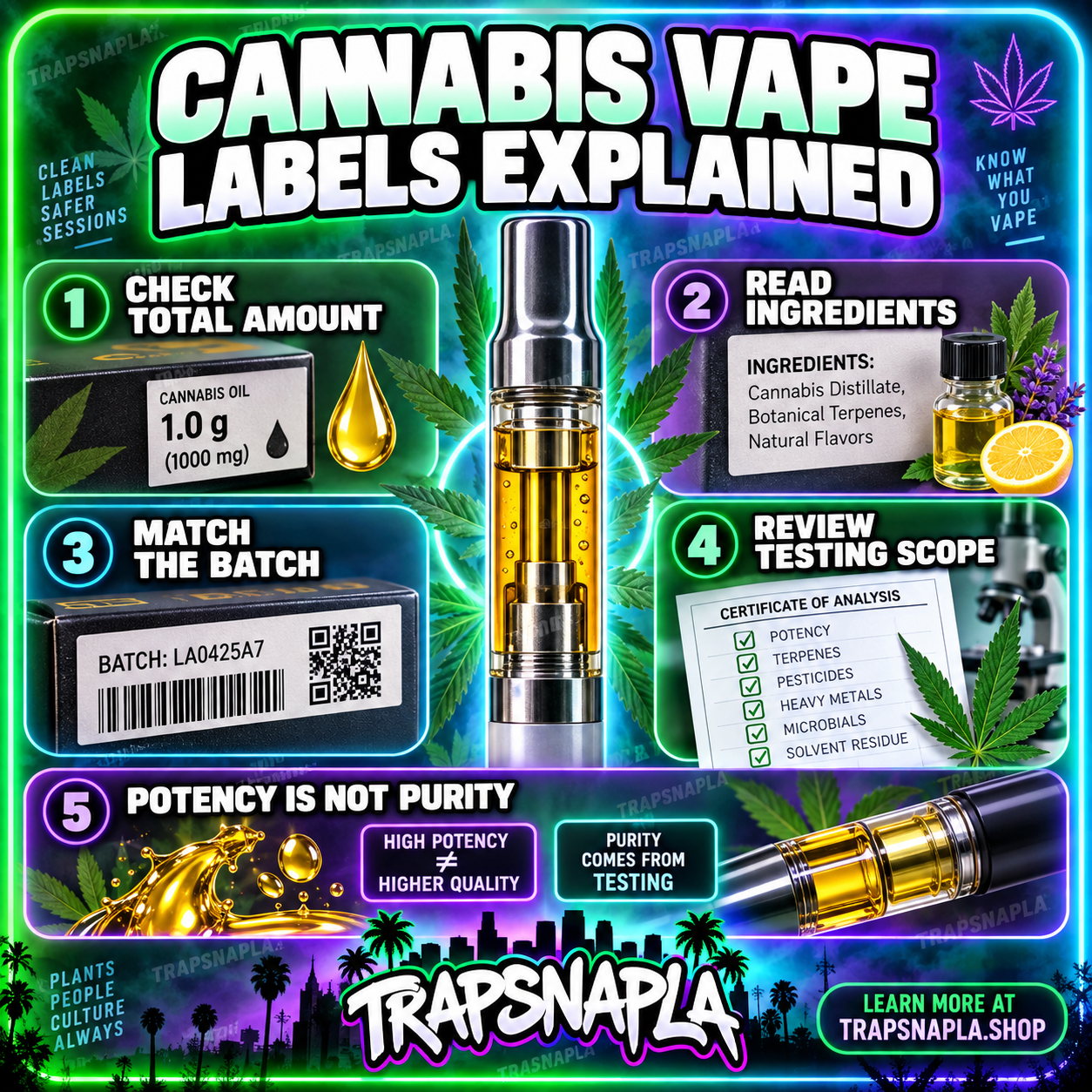
A cannabis vape label might give you a huge THC number, a strain name, a flavor, and a phrase like “premium live resin.” It can feel like a lot of information while still leaving the basic ingredients unclear. Reading cannabis vape labels means separating oil concentration, device information and the aerosol produced by heating.
The easiest way to read the label is to separate three things: the liquid inside, the device around it, and the aerosol produced when it’s heated. Those are related, but they aren’t identical.
Once you keep those pieces apart, the label becomes easier to question. A claim about the oil doesn’t automatically answer a question about the hardware, and neither one tells you everything about the final inhaled aerosol.
How to read cannabis vape label ingredients
A strain or flavor name isn’t a complete ingredient list. It may describe an intended profile without identifying every cannabinoid, terpene, or other added substance.
Look for plain information about what is actually in the formulation. If the label says “blend,” the next question is a blend of what. If it says “with” a particular extract, that doesn’t necessarily mean the entire contents are that extract.
You should not have to infer ingredients from packaging color or a familiar name. A clear label distinguishes the material’s identity from the mood or flavor story used to describe it. Those details can coexist, but they serve different purposes.
Extract names describe only part of the picture
Distillate generally refers to a refined extract focused on selected compounds. Live resin generally refers to a solvent-based extract from fresh-frozen cannabis. Rosin refers to a mechanically obtained concentrate made through pressing an appropriate starting material.
Those terms provide useful context, but a finished vape may contain a mixture. Added terpenes or other components can make the final formula different from the simple extract description.
This is why “live resin blend” deserves to be read literally. It tells you there’s a blend, not the percentage of every ingredient. A prominent extract name should not be allowed to stand in for information the label never actually supplies.
What the THC percentage tells you
A THC percentage describes concentration under the stated measurement. It isn’t a fixed amount delivered each time the device is used.
The device, how it operates, and the pattern of use can influence exposure. So the percentage doesn’t translate directly into a universal amount per puff or a predictable effect for every person.
It also doesn’t rank overall safety. A high THC figure says nothing by itself about residual solvents, metals, additives, or other concerns. Those require relevant information and testing. [2] The number may be accurate and still answer far less than the front of the package makes it seem to answer.
Grams capacity and puff counts are different fields
An amount in grams may describe the mass of the contents. A capacity figure may describe what the device or container holds. A puff-count claim is an estimate tied to assumptions about use.
None of those fields should be silently substituted for an exact THC amount delivered to a person. A stated puff count isn’t a dosing standard, and two puffs from different devices aren’t guaranteed to be equivalent.
This is one place where familiar consumer-product language can be misleading. A larger capacity or a longer-lasting claim tells a product story, but it doesn’t automatically explain chemical exposure. Read the field for the question it actually answers.
Added terpenes need their own explanation
Terpenes contribute to aroma and may be part of an extract or added separately. A label may describe them as cannabis-derived or botanically derived.
That source information can be useful, but it doesn’t settle the safety of the entire formulation. The amount, other ingredients, and route of exposure still matter.
Most importantly, an ingredient being used in food doesn’t establish that breathing it in is safe. “Found in fruit” and “appropriate for an inhaled aerosol” are different claims. A pleasant flavor should not distract from the need for clear ingredients and evidence relevant to the way the product is actually used.
Why vitamin E acetate gets mentioned
Vitamin E acetate became a major concern during the investigation of EVALI, the outbreak of e-cigarette or vaping product use-associated lung injury. Researchers found a strong association between vitamin E acetate and the outbreak in the samples and patients studied. [1]
The lesson isn’t that one warning phrase solves every vape-safety question. It’s that substances acceptable in some other contexts can be harmful when inhaled in a different form.
“No vitamin E acetate” is therefore not a complete safety certificate. It addresses one ingredient claim. The rest of the formulation, the device, and the aerosol still need their own evaluation. Removing one known concern doesn’t prove that every possible concern has been removed.
Liquid testing is not the same as aerosol testing
A report about the liquid describes the sampled liquid under the tests performed. Heating produces an aerosol, a different exposure involving the formulation and the device together.
That distinction matters because the hardware and heating process are part of what reaches the user. A cannabinoid result for an input oil can’t automatically answer questions about the entire finished system.
When reading a report, check the sample description carefully. Was it a bulk ingredient, finished liquid, cartridge, or an aerosol test? Those labels tell you what the evidence is actually about. A detailed document is only useful when its scope matches the question.
What a useful batch report should show
The product name, batch identifier, sample type, laboratory, and dates should be clear. If the report belongs to another batch or an ingredient used earlier in production, that limitation matters.
Then separate potency from other tests. Cannabinoid measurements don’t substitute for residual-solvent, pesticide, metal, or other relevant results. California’s testing resources explain these as distinct categories. [2]
A PASS means the sample met the criteria used for the reported tests. It doesn’t establish that the product is risk-free or suitable for every person. The value of testing comes from specific evidence, not from treating a passing box as a universal promise.
The bubble test is not a lab test
You may see advice about judging a vape by how a bubble moves, how thick the liquid looks, or whether the color matches a preferred shade. Those observations can’t establish ingredient identity or rule out contaminants.
Temperature and formulation can influence appearance and flow. Without measuring the substances in question, a visual trick can’t provide the same information as an appropriate analytical test.
The same goes for whether the product feels smooth. A sensation can be real without proving safety. If something seems damaged, unusual, or poorly identified, don’t try to resolve the uncertainty by using more of it to see what happens.
Breathing symptoms deserve attention
Cannabis-related inhalation should not be treated as harmless simply because there’s no visible smoke. The CDC describes lung-health concerns associated with cannabis and notes important uncertainties around different routes and products. [3]
If someone develops concerning breathing symptoms or chest pain after vaping, seek medical advice rather than relying on the product’s label to explain them away. Severe trouble breathing or other emergency symptoms call for urgent help.
Tell the clinician what was used and keep the packaging if it’s available. A clear account of the product and timing is more helpful than assuming a familiar brand name rules out a problem.
Read beyond the headline number
A useful cannabis vape label should help explain the formulation, the batch, and the relevant evidence. THC percentage, extract names, capacity, and puff estimates each answer limited questions.
The clearest mental model is still the simplest one: liquid, device, aerosol. Don’t let a claim about one silently become a claim about all three.
You don’t need a hardware manual to spot the gaps. You just need to notice when a label gives you a catchy description instead of the ingredient or testing information you actually wanted.
Sources
1. Blount and colleagues — Vitamin E acetate and EVALI investigation.
2. California DCC — Testing laboratories.
3. CDC — Cannabis and lung health.
Related educational articles
- Distillate vs live resin and what each term means
- How to read a cannabis lab report without getting lost
- What cannabis terpenes are and why weed smells different
Frequently asked questions about cannabis vape labels
Does a cannabis vape cartridge label need readable text in California?
California’s manufactured-product checklist requires clear, legible required labeling at a minimum 6-point size. A cartridge’s small dimensions do not turn a QR code into a replacement for required attached information. California manufactured-product label checklist.
What does “not child-resistant after opening” mean on a vape package?
California permits specified inhaled-product packaging with initial child resistance. That warning means the opened package no longer meets that initial barrier; it should not be interpreted as lifetime child resistance. California child-resistant packaging guidance.
Does a cannabis lab’s ISO accreditation mean a vape is certified organic?
No. California describes ISO/IEC 17025 accreditation for laboratory competence. That is a laboratory standard, not an organic certification or a blanket endorsement of every finished vape tested by that laboratory. California testing-laboratory guidance.
Tags: cannabis vape label font and ingredient information, California cannabis vape packaging warning meaning


